
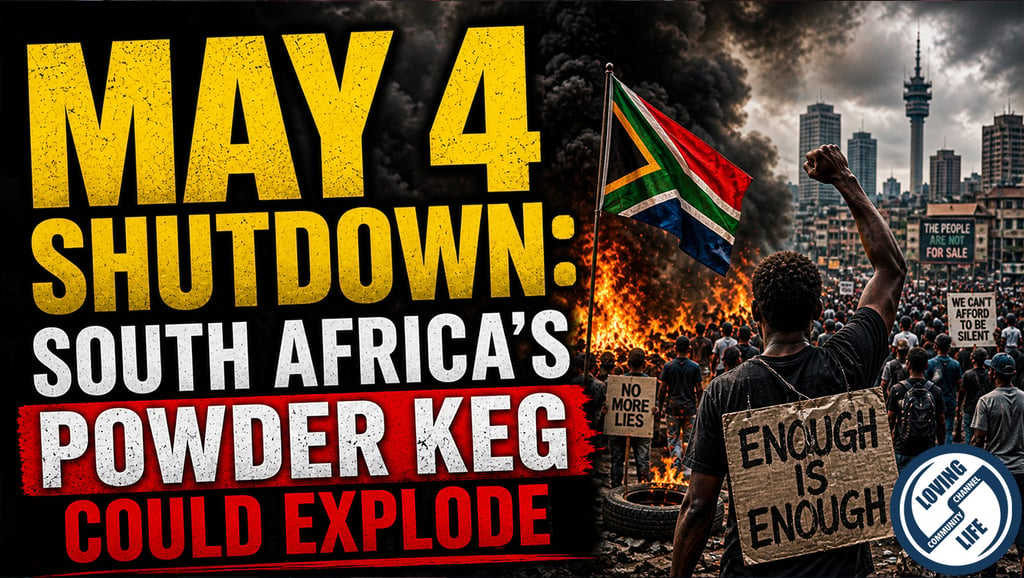
MAY 4 NATIONWIDE SHUTDOWN: SOUTH AFRICA’S POWDER KEG COULD EXPLODE
South Africa is on the brink. On Monday 4 May 2026 groups backed by Operation Dudula are calling for a full nationwide shutdown demanding every foreign national documented or undocumented leave the country. Loving Life cuts through the noise: the frustration over jobs crime and borders is real but turning it into violence and scapegoating is a dangerous dead end. Here is the honest take on what is really at stake.
South Africa is two days away from a moment that could define the next chapter of this country’s story and it’s not looking pretty.
On Monday, 4 May 2026, a group calling itself the Concerned Citizens and the Voters of South Africa is calling for a full nationwide shutdown. Their demand is crystal clear and uncompromising: every foreign national in the country, documented or undocumented, must leave. They want businesses, schools, workplaces, and transport to shut down in support. They plan to hand over a memorandum to President Cyril Ramaphosa and Gauteng Premier Panyaza Lesufi. And they’re not mincing words: if the government doesn’t act, they say officials should resign or be removed, even threatening that failure to do so could lead to civil war.
This isn’t some fringe social media rant. The call is backed by established movements like Operation Dudula and March and March. Marches have already been happening in Johannesburg, Durban, Pretoria, and parts of the Eastern Cape. Videos of vigilante groups confronting and attacking foreign nationals, including Ghanaians and Nigerians, have gone viral. Foreign-owned shops are closing early out of fear. Ghana has formally summoned South Africa’s envoy and lodged protests over the incidents. The United Nations has condemned the rising xenophobia. And South African police have been placed on high alert, with clear warnings that anyone involved in violence, intimidation, or incitement will be arrested.
As of today, Saturday 2 May 2026, the tension is thick. Foreign nationals are living in fear. Communities are on edge. And the country is holding its breath to see whether Monday becomes a day of peaceful protest or something far darker.
Who’s Behind This and What They’re Actually Saying
The organisers aren’t hiding their position. One widely circulated message from the group states plainly: “We are xenophobic. We want all foreigners, documented or not, out of this country as a matter of urgency.” They frame the shutdown as a last resort to “avoid civil war” and pressure what they call a “useless or traitorous” Government of National Unity.
They’re calling on taxi associations, student organisations, churches, hostel residents, and ordinary citizens to join. The goal is total paralysis on the day: no schools, no businesses, no movement, to force the state to act on immigration.
This isn’t new. Operation Dudula (“push back” in isiZulu) has been running anti-immigrant campaigns for years, targeting undocumented migrants, foreign-owned spaza shops, and what they see as foreigners taking jobs and committing crime. March and March has joined the chorus. What’s different now is the scale, the coordination, and the timing, just ahead of local elections where tough talk on immigration wins votes.
The Frustrations Are Real And They Matter
Let’s not pretend the anger comes from nowhere.
South Africa’s official unemployment rate sits at 31.4 percent (Q4 2025), with the expanded rate (including discouraged workers) hovering around 42 to 45 percent. Youth unemployment is catastrophic, over 57 percent officially and as high as 62 percent in some measurements. Millions of young South Africans wake up every day with no realistic path to a job, a future, or dignity.
At the same time, Statistics South Africa puts the immigrant population at roughly 3 million people, around 5 percent of the total population. Many run small businesses, work in sectors where locals are scarce, or live in the same townships and informal settlements as unemployed South Africans. Crime statistics, service delivery failures, and visible overcrowding in hospitals and schools add fuel to the fire.
When a South African graduate can’t find work while foreign nationals run thriving shops or fill certain roles, the resentment isn’t imaginary. When border control has been weak for years and undocumented migration continues, people notice. When politicians talk about “economic transformation” but fail to create real opportunities for citizens, the betrayal stings.
These are legitimate grievances. South Africans have every right to demand that their government puts South African citizens first in jobs, in housing, in policing, and in basic service delivery. That’s not xenophobia. That’s basic national responsibility.
But Scapegoating Foreigners Won’t Fix Anything
Here’s where the movement goes off the rails.
Blaming foreigners for all of South Africa’s problems is a classic distraction tactic. The real culprits, decades of ANC governance failures, corruption, cadre deployment, energy collapse, education system meltdown, and broken institutions, remain comfortably in power while the poor turn on each other.
We’ve seen this movie before. In 2008, xenophobic violence killed at least 62 people and displaced thousands. In 2015, 2019, and 2022 we had deadly flare-ups. Each time the pattern is the same: frustration boils over, foreigners (mostly fellow Africans) are attacked, shops are looted and burned, lives are ruined, and then the government issues statements, makes arrests, and everything quietly returns to the same broken status quo.
The poorest South Africans and the poorest foreigners usually bear the brunt. The politicians, the tenderpreneurs, and the connected elites? They stay untouched.
Violence and mass intimidation don’t create jobs. They don’t fix the borders. They don’t build houses or schools. They just destroy what little economic activity exists in the townships and informal economy, the exact places where most ordinary South Africans are trying to survive.
International Backlash and the Global Cost
The world is already watching. Ghana’s formal protest and summoning of South Africa’s envoy is just the start. Mozambique’s Renamo has called for urgent government talks. The UN, Amnesty International, and various African voices are condemning the violence. South Africa’s reputation as the economic powerhouse of the continent and a supposed leader in Pan-Africanism takes another hit every time this happens.
For a country that likes to lecture the world about human rights and solidarity, the optics are terrible. And the economic cost is real: investor confidence, tourism, trade relations, and the African Continental Free Trade Area all suffer when images of burning shops and terrified migrants dominate global headlines.
What Real Solutions Would Actually Look Like
If the anger is real, and it is, then the response has to be real too.
South Africa needs strict, enforceable immigration control at the borders and within the country. It needs proper vetting and prioritisation of citizens in public service jobs, state contracts, and scarce skills areas. It needs a serious crackdown on crime, including crimes committed by undocumented foreigners, without racial profiling that crosses into abuse. It needs massive investment in local skills, education, and economic growth that actually creates jobs for South Africans. And it needs honest leadership that stops blaming “apartheid legacy” and “white monopoly capital” for every failure while quietly benefiting from the current broken system.
Demanding that the state puts citizens first is not hateful. It’s the bare minimum any functional government owes its people. Turning that demand into attacks on fellow human beings is where it becomes morally and practically disastrous.
The Loving Life Take
This country is exhausted. People are angry, scared, and desperate for change. The May 4 shutdown is a symptom of deep failure, not just of policy, but of leadership that has left millions feeling abandoned in their own land.
We can acknowledge the pain without excusing the poison. Culture, identity, and national belonging matter. Fairness matters. Protecting your own people first is not bigotry. It’s common sense.
But becoming the kind of nation that burns shops and attacks neighbours out of frustration? That’s not resistance. That’s self-destruction.
Monday is coming fast. The choice is ours: channel the legitimate rage into real pressure for competent governance, secure borders, and economic reform, or let it explode into the same old cycle of violence, shame, and zero progress.
South Africans deserve better than both the failed state that created this mess and the mob response that makes it worse.
That’s the take. The frustration is real. The scapegoating is dangerous. The solutions are hard, but they exist.
What do you think is going to happen on May 4? Drop your honest thoughts below. Just keep it real.