
Malema Claims: The Malema presidency was stolen from him by the ANC
Julius Malema claimed at the 15 May 2026 Frank Dialogue event that he was robbed of the presidency by the ANC. His address mixed racial theories, conspiracies and radical policies while offering few practical fixes. Productive citizens and businesses continue to manage high unemployment, crime, infrastructure failure and fiscal waste under current governance. This piece examines the gap between such claims and South Africa’s measurable realities.
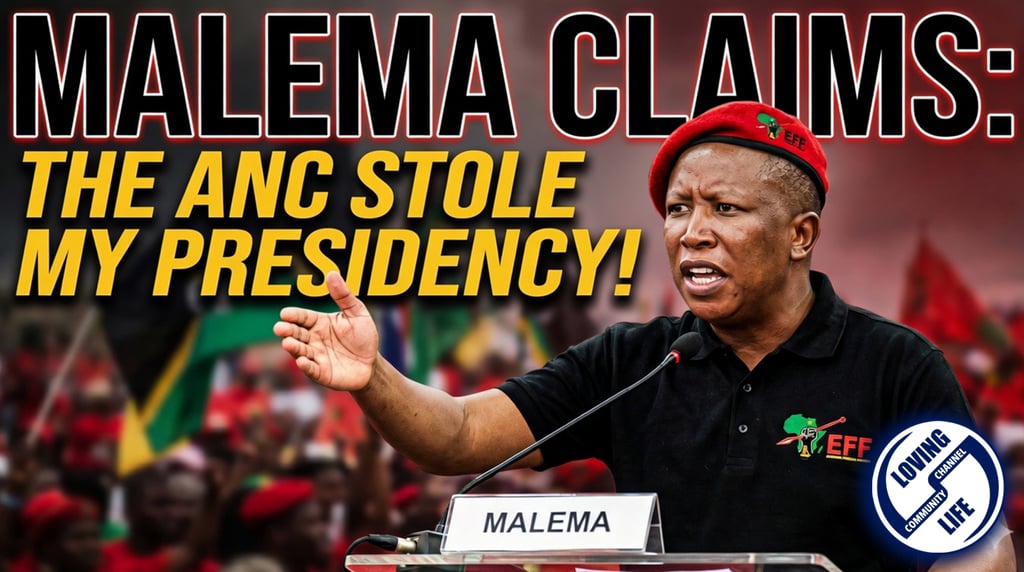
On 15 May 2026 Julius Malema told a Frank Dialogue audience that he was robbed of the presidency by the ANC. The statement formed the centrepiece of a speech that blended personal grievance, racial framing, conspiracy references and calls for sweeping state control. It provided limited detail on how South Africa would generate jobs, restore infrastructure or cut crime under his preferred policies.
Productive citizens who own businesses, run commercial farms and pay the majority of personal and corporate taxes expect leaders to address operational failures. They face daily costs from unreliable electricity, broken logistics and municipal collapse. Framing every difficulty as racial theft or external sabotage does not repair power stations, clear container backlogs or secure rural properties.
Stats SA released Q1 2026 labour data on 13 May. The official unemployment rate rose to 32.7 percent from 31.4 percent in Q4 2025. Employment fell by 345 000 while the number of unemployed people climbed to 8.1 million. Youth unemployment for ages 15 to 24 reached 60.9 percent. These figures confirm a labour market that fails to absorb new entrants and limits expansion for employers who create formal jobs.
GDP growth for 2025 came in at 1.1 percent, with Q4 recording 0.4 percent quarter-on-quarter expansion. This remains below levels needed to reduce unemployment and fund public services. Productive enterprises compete in a low-growth environment where policy uncertainty and rising compliance costs deter investment. Many business owners report that expansion plans stay on hold while they manage self-funded alternatives for power, security and infrastructure.
The Auditor-General’s report for 2024/25 showed continued financial control failures. Irregular and wasteful expenditure reached significant levels across national and provincial government. Only a minority of auditees received clean audits. Tax contributors effectively subsidise repeated bailouts for state-owned entities such as Eskom and Transnet while their own operations absorb the cost of collapsed municipal services.
Crime numbers show modest improvement but remain elevated. SAPS Q3 2025/26 data recorded a 6.7 percent drop in contact crime and an 8.7 percent decline in murders compared with the same period a year earlier. Absolute levels stay high. Farm attacks and rural violence continue. AfriForum’s 2025 monitoring logged 184 farm attacks and 29 farm murders. Gauteng, Limpopo and Mpumalanga recorded significant incidents. Commercial farmers who produce food and earn export revenue invest heavily in private security because state response times and rural policing fall short.
Malema’s speech returned repeatedly to racial dynamics as the primary explanation for South Africa’s shortfalls. Productive minority communities, the businesses and farms that generate most formal employment and tax revenue, require secure property rights, reliable services and predictable regulation. Policies that expand nationalisation of mines, banks and other sectors or accelerate expropriation without compensation have clear track records elsewhere. They tend to reduce output, trigger capital flight and shrink the tax base. South Africa’s existing state-owned companies already consume repeated taxpayer support while delivering unreliable performance.
Infrastructure decay adds direct costs. Commercial operations run diesel generators, drill boreholes and arrange private waste removal because municipalities fail to deliver. Ports and rail networks suffer chronic delays that raise export expenses for farmers and manufacturers. These self-funded substitutes mean productive citizens pay taxes once to government and again to replace what government does not deliver.
Education outcomes limit the available skills pool. Employers across sectors report shortages in technical, engineering and professional competencies. Cadre deployment and procurement irregularities identified in Auditor-General reports weaken institutions that should train the next generation of workers. Radical redistribution priorities that override competence criteria risk deepening these gaps and further eroding service standards.
Personal security remains a core operating expense. Businesses budget for insurance, guards and electronic systems. Farmers allocate substantial turnover to perimeter protection and rapid-response arrangements. Even with quarterly reductions in national crime figures, the baseline threat level discourages investment and prompts skills emigration.
Malema presented his views as a coherent ideology centred on historical grievance and state expansion. Yet measurable governance failures, from fiscal waste to service delivery collapse, explain most of the country’s underperformance. Productive citizens continue to carry the burden through higher costs, lost opportunities and personal risk. Realistic solutions lie in secure property rights, competent administration, reduced regulatory burden and sound fiscal management. Rhetoric that prioritises personal claims of stolen destiny over these fundamentals offers no relief to those who keep the economy functioning.