
Hoërskool Middelburg (Eastern Cape) Faces Possible Closure Over Unpaid Teacher Salaries
Hoërskool Middelburg in the Eastern Cape Karoo has announced it will close from 18 May 2026 after spending over R700,000 of its own money on unpaid teacher salaries. A look at the crisis, the department’s response, and what it means for rural schools.
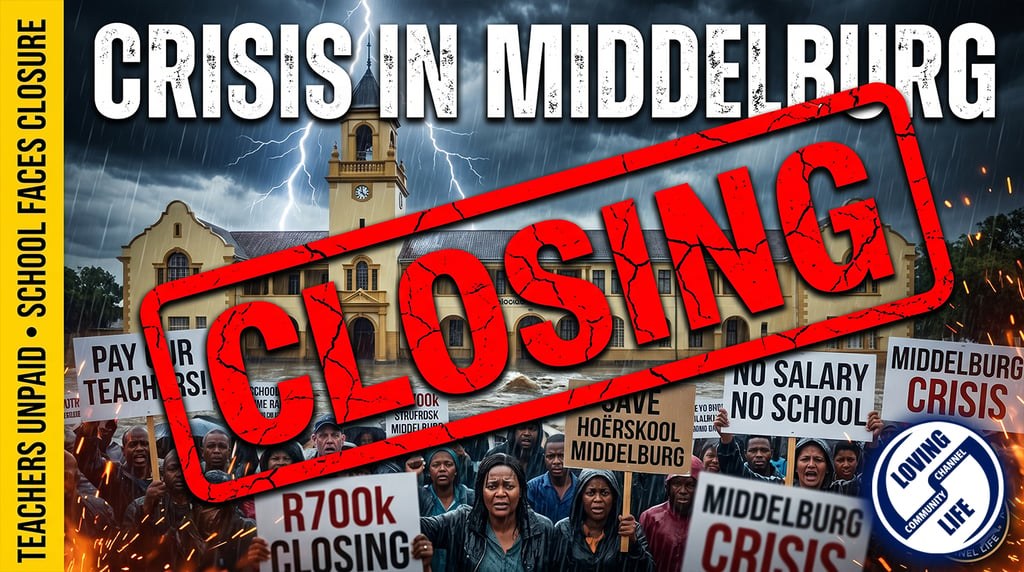
On 14 May 2026, Hoërskool Middelburg in the upper Karoo region of the Eastern Cape made a dramatic announcement: the school would close its doors from Monday 18 May until further notice. The School Governing Body (SGB) stated that it could no longer sustain operations after the provincial Education Department allegedly failed to appoint and pay several educators since 2025. In desperation, the school had already spent more than R700,000 of its own limited funds to cover salaries that should have been the department’s responsibility.
This small historic school currently serves approximately 199 learners. According to post-provisioning norms, it qualifies for roughly eight educator posts — one principal, one head of department, and six post-level-one teachers. Like many rural schools, it struggles with persistent vacancies, particularly in subjects such as Afrikaans. The SGB emphasised that the financial burden had become completely unsustainable, especially with the critical June examinations fast approaching.
The announcement sent shockwaves through the tight-knit Karoo community. For parents and learners, the sudden threat of closure raises serious concerns about disrupted learning, exam preparation, and the future of this long-standing institution.
Department’s Response
The Eastern Cape Department of Education pushed back against the closure notice. Spokesperson Velani Gola confirmed that the department is aware of the situation and is actively processing payments. The department insists that classes must continue as normal on Monday and reminded everyone that, under the South African Schools Act (SASA), only the Head of Department has the legal authority to formally close a public school.
This back-and-forth has left families in limbo as the new school week begins.
A Symptom of Deeper Problems
Hoërskool Middelburg’s crisis is not an isolated incident. While South Africa consistently allocates around 21% of its total government expenditure to basic education — one of the highest proportions in the world — and spends between 6% and 7% of GDP on the sector, the reality on the ground in provinces like the Eastern Cape tells a different story.
Provincial departments continue to battle with delayed payments to schools and educators, chronic post-provisioning shortages, administrative bottlenecks, and under-resourcing in rural areas. Small schools with modest learner numbers are especially vulnerable. They often end up using SGB funds or community donations to plug holes that should be covered by the state.
Recent investigations, including those by the Special Investigating Unit (SIU), have exposed serious procurement irregularities and funds being spent under questionable “emergency” pretences. Critics argue that inefficiencies, cadre deployment, and bureaucratic red tape prevent money from reaching the schools where it is needed most. In many cases, rural Afrikaans-medium schools like Hoërskool Middelburg rely heavily on local farming and business communities to subsidise basic operations instead of infrastructure improvements or extracurricular programmes.
A School With Deep Roots
Hoërskool Middelburg was founded in 1880 by Mr D.J. Wilkock. It soon became a government school and has served generations of Karoo families ever since. Its motto, “Karakter en kennis” (Character and Knowledge), captures its long tradition of holistic education in a traditional Afrikaans environment. The well-maintained historic buildings stand as a symbol of community pride in the upper Karoo town of Middelburg.
The current crisis feels particularly painful because this is not a failing school — it is a historic institution doing its best under difficult circumstances. The SGB has reportedly exhausted its reserves after covering teacher salaries for more than a year. Local contributions that could have gone toward facilities or learner support have instead been redirected to meet the province’s obligations.
What Happens Next?
As of 15 May 2026, no further update has come from the school. The department maintains that payments are being processed and that normal schooling should resume. The coming days will be critical. If the department follows through quickly, the immediate threat of closure may be averted. If not, learners, teachers, and parents will face further uncertainty at one of the most important times in the academic year.
This situation once again throws a spotlight on the gap between national education spending figures and actual delivery in rural provinces. High budget allocations mean little when small schools are forced to choose between paying teachers out of their own pockets or shutting down.
Communities that have built and sustained these institutions for well over a century deserve better. They pay taxes, contribute voluntarily through SGBs, and entrust their children to the public system expecting at least basic functionality in return.
The eyes of many rural schools across the Eastern Cape will be on Hoërskool Middelburg in the coming week. How this dispute is resolved could set an important precedent — either as a warning of recurring crises or as evidence that the department can respond effectively when pushed.
Parents, learners, and staff deserve clarity and stability. The broader education system desperately needs systemic fixes so that stories like this do not keep repeating year after year.