
Labour Law Amendments 2026: Higher Costs for Productive Businesses in High-Unemployment Economy
South Africa’s 2026 Labour Law Amendment Bills double severance pay, extend gig worker protections and add compliance costs for on-call work and parental leave. In a 32.7% unemployment economy these changes hit productive minority communities who run businesses and farms hardest. Analysis of impacts on hiring, SMEs and job creation.
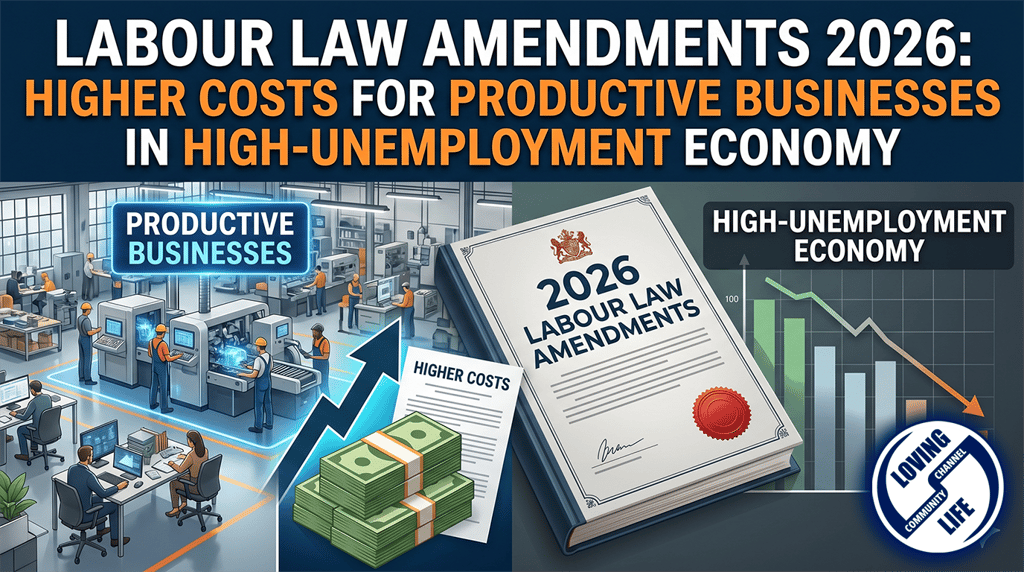
South Africa’s proposed Labour Law Amendment Bills, published in late February 2026, mark one of the most substantial changes to employment rules in more than a decade. The Labour Law Amendment Bill 2025 and Labour Relations Amendment Bill 2025 emerged from NEDLAC talks between 2022 and 2024. Public comments closed on 28 March 2026. As of mid-May 2026 the bills are moving through Parliament.
Productive minority communities who own and run businesses, commercial farms and enterprises that employ people and pay the bulk of taxes must examine these changes closely. The bills add costs, reduce flexibility and extend protections in an economy where unemployment reached 32.7 percent in the first quarter of 2026. That figure is up from 31.4 percent in the fourth quarter of 2025. Eight point one million people are unemployed, an increase of 301 000 in one quarter. Youth unemployment stands at 45.8 percent.
Under the Basic Conditions of Employment Act changes, parental leave becomes gender-neutral. A single parent receives four months. Two employed parents share four months plus ten days, with the birthing mother given priority. Adoption leave extends to children under six years. These adjustments align with court rulings but add direct leave costs for employers who already manage tight margins.
New rules for on-call, zero-hours and unpredictable work require written agreements that specify guaranteed hours, maximum hours, availability periods and reasonable notice. The aim is to limit exploitative contracts. In practice this reduces the ability of businesses to match staffing to demand. Retail, agriculture, logistics and service firms that rely on variable hours will face higher fixed costs and compliance burdens.
The earnings threshold updates to between R269 600 and R1.8 million per year for certain exemptions. High earners above R1.8 million lose automatic reinstatement rights in some unfair dismissal cases. This offers limited relief for senior roles but does not offset broader cost increases.
Non-payment of pension or benefit contributions will be treated as wage theft. Enforcement will tighten. Businesses already struggling with cash flow after load-shedding, infrastructure failures and rising input costs now risk criminal-level penalties for administrative delays.
The Labour Relations Act amendments introduce a broader definition of employee. Platform, delivery and home-based workers gain a presumption of employment unless the business proves genuine independence. These workers receive rights to organise, bargain and claim unfair dismissal under a new Schedule 11. This shifts gig and contract work toward permanent status. Many productive businesses use such arrangements to stay agile. The change raises the risk of reclassification, back-pay claims and higher payroll costs.
Severance pay for operational requirement retrenchments doubles from one to two weeks per year of service. In a low-growth environment this increases the price of adjusting workforce size. Retrenchments already carry high procedural risk. Doubling severance makes it more expensive to respond to economic pressure.
Small and new businesses under 50 employees may receive temporary exemptions from some bargaining council agreements. This is narrow relief. Most productive minority-owned firms exceed this threshold or operate in sectors covered by councils that set wages above what market conditions support.
CCMA powers expand. Dispute duplication decreases. Secret ballots apply to certain union actions. These measures may bring modest procedural clarity. They do not address the core rigidity that deters hiring.
Business analysts warn that added costs and protections will discourage employment, particularly among SMEs. In an economy losing 345 000 jobs in one quarter, further rigidity risks more mechanisation, outsourcing or simple reluctance to expand headcount. Youth and inexperienced workers suffer most when entry-level positions become too expensive.
Government and labour present the bills as modernisation that protects vulnerable workers and promotes fairness. Minister Nomakhosazana Meth described them in May 2026 as balancing protections with operational needs. Yet the structural unemployment rate above 32 percent shows that existing labour rules already limit job creation. Adding layers of cost and compliance does not solve this. It compounds it.
Productive minority communities bear a disproportionate share of the tax burden and employment responsibility. They generate the revenue that funds social grants and public services. When labour laws raise the cost of hiring and firing, these businesses absorb the hit first. Compliance administration diverts time and capital from growth. Retrenchement costs rise precisely when economic conditions force adjustments.
The bills do not create jobs. They redistribute risk from workers to employers in a market where demand for labour already falls short of supply. Gig workers gain protections. Businesses lose flexibility. SMEs that could scale with variable contracts now face full compliance burdens.
Implementation, if the bills pass, will be phased. Further parliamentary changes remain possible. Productive businesses cannot wait for final text. They must review contracts, leave policies, on-call arrangements and contractor relationships now.
Self-reliance remains essential. Businesses should document genuine independent contractor status with clear agreements and evidence of separate businesses. They must budget for higher severance and leave costs. They should tighten performance management to reduce dismissal disputes. High-earning roles may benefit from the new threshold, yet overall exposure grows.
South Africa’s rigid labour market has long been identified as a barrier to job creation. These amendments move further away from flexibility. In an environment of infrastructure decay, energy instability, crime and policy uncertainty, employers already operate with limited room. Additional rules that increase costs without improving productivity or growth will accelerate caution.
Not every provision targets productive minority communities. The pattern of outcomes does. Businesses that employ, invest and pay taxes face higher operational costs while the broader economy fails to absorb new entrants. Unemployment climbs. Discouraged work-seekers exit the statistics. The cycle continues.
Productive citizens must maintain vigilance. Protect cash flow. Retain skilled staff through competitive but sustainable packages. Avoid over-expansion that later requires costly retrenchment. Diversify where possible. Document everything.
The bills reflect ongoing tension between worker protections and labour market flexibility. In a country with structurally high unemployment the balance has shifted further toward protections. The cost lands on those who create the jobs. Productive minority communities, who keep enterprises running despite the challenges, will pay again through reduced hiring, higher expenses and continued pressure on margins.
Clear-eyed realism is required. These changes will not lower unemployment. They may raise it by making employment more expensive. Businesses that survive will be those that adapt early, control costs and prioritise efficiency. The rest will contract or close. South Africa’s productive base cannot afford further erosion.