
South Africa Unemployment Rate Rises to 32.7 Percent in Q1 2026
South Africa unemployment rate climbed to 32.7% in Q1 2026 with 8.1 million unemployed and employment down 345000. Analysis of impacts on productive minority communities who drive business and farming. Structural failures and provincial breakdowns examined.
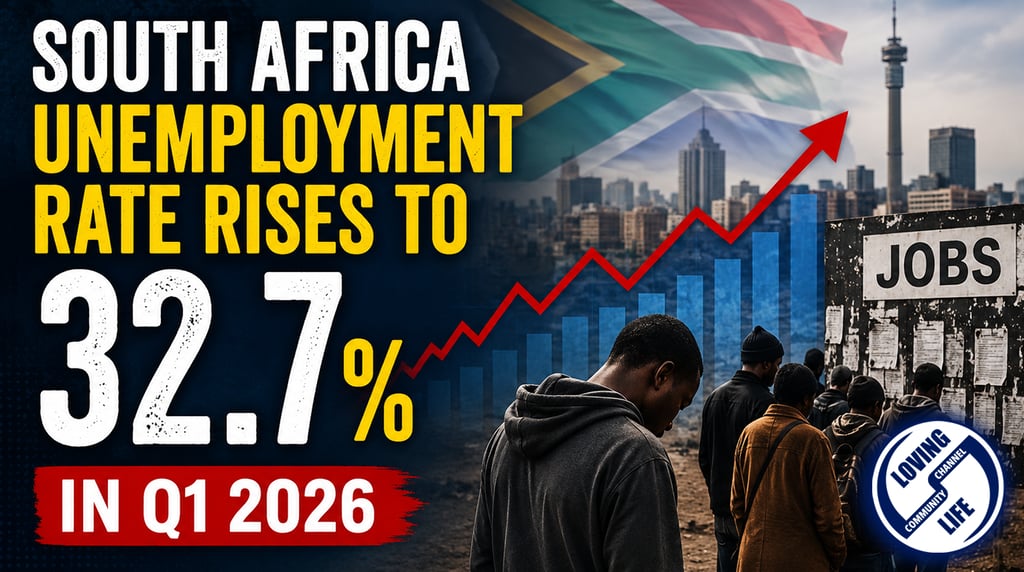
South Africa’s official unemployment rate increased to 32.7 percent in the first quarter of 2026. This marks a rise of 1.3 percentage points from 31.4 percent in the fourth quarter of 2025. Statistics South Africa released the Quarterly Labour Force Survey on 12 May 2026. The data shows 301000 more people out of work. The total number of unemployed reached 8.1 million.
The working-age population stood at 42.2 million. The labour force contracted slightly to 24.9 million. Employment fell by 345000 to 16.8 million. These numbers confirm a sharp reversal after modest gains late in 2025. The absorption rate dropped to 39.7 percent. Only four out of every ten working-age adults hold a job.
Productive minority communities who run businesses, operate commercial farms and pay the bulk of taxes feel these pressures directly. They create employment and drive economic activity yet operate in an environment where job creation remains weak. Every percentage point rise in unemployment signals fewer customers, higher security costs and greater strain on the tax base that funds public services.
Broader measures paint a worse picture. The LU3 rate, which includes the potential labour force, reached 43.7 percent. The composite measure of labour underutilisation hit 46.3 percent. Discouraged job-seekers increased by 178000 to 3.9 million. Many have simply stopped looking. This hidden slack affects demand for goods and services produced by formal businesses.
Sector results show uneven movement. Manufacturing added 38000 jobs and mining gained 32000. Agriculture recorded a small increase of 10000. These areas provide some stability for productive operations. Losses hit harder elsewhere. Community and social services shed 206000 positions. Construction lost 110000. Transport dropped 30000. The formal sector declined by 189000 jobs and the informal sector by 127000.
Provincial data reveals concentration of pain. KwaZulu-Natal was the only province to gain jobs, adding just 6000. North West lost 80000. Gauteng dropped 67000. Mpumalanga fell by 54000. Eastern Cape and Limpopo each lost 43000. Gauteng and the Western Cape host many minority-owned businesses and commercial operations. Job losses in these regions reduce local spending power and increase pressure on infrastructure already under strain.
Youth unemployment stands at 45.8 percent for those aged 15 to 34. This group makes up nearly half the working-age population. Their employment numbers fell by 258000 while unemployed youth rose by 181000. The rate for 15- to 24-year-olds reached 60.9 percent. The NEET rate, covering those not in employment, education or training, sits at 45.6 percent. Young people remain concentrated in elementary occupations and sales roles. Skills mismatches persist. This long-term trend limits the future labour pool available to expanding enterprises.
Productive minority communities invest in training and often hire from this pool when conditions allow. Yet repeated policy failures leave large numbers unprepared for the demands of modern business. The result is chronic high unemployment above 30 percent for more than a decade. This is not a temporary dip. It reflects deep structural problems including slow growth, infrastructure decay and regulatory barriers.
Government responses continue to emphasise long-term reforms and infrastructure plans. Mining and agriculture showed resilience in the quarter. However, overall job creation fails to match population growth. Electricity supply remains inconsistent in many areas. Road and rail networks hinder efficient movement of goods. These factors raise costs for businesses that employ people and generate revenue.
Economists point to skills mismatches and weak investment. Opposition parties describe a structural crisis. The data arrived amid rising fuel prices and inflation concerns. For those who own farms or run factories, each quarter of weak numbers means tighter margins and difficult decisions on staffing.
The updated questionnaire in the survey aligns with international standards. Headline figures remain comparable to previous releases. Year-on-year comparisons show mixed results but the first quarter of 2026 erased recent progress. Time-related underemployment affected 795000 people. Lower education levels correlate with higher unemployment. Women face heavier burdens in discouraged categories.
These trends carry direct consequences for productive citizens. Businesses in manufacturing, retail and services rely on stable demand. High unemployment reduces that demand. Crime patterns linked to joblessness increase costs for private security. Tax revenue comes under pressure as fewer people earn formal wages. Public services deteriorate further, hitting everyone but placing extra load on those who already contribute disproportionately.
Minority communities have built successful operations despite these headwinds. They employ large numbers across sectors. Many support extended families and community initiatives. Yet government policies that fail to prioritise growth erode the foundation they rely on. Land reform uncertainty affects agricultural investment. Black economic empowerment requirements add compliance costs. Infrastructure collapse in key corridors raises transport expenses.
Self-reliance remains essential. Productive businesses continue to adapt through efficiency gains, technology adoption and private infrastructure solutions. Vigilance on security and sound financial management protect what has been built. Diversification into resilient sectors such as mining services or export agriculture offers some buffer.
The absorption rate of 39.7 percent signals a labour market that excludes millions. Potential labour force numbers climbed by 240000. This pool represents untapped capacity but also untapped demand. Until economic growth accelerates above population increases, unemployment will hover at damaging levels.
Provincial differences matter. The Western Cape maintains the lowest official rate around 19.6 to 24.8 percent. Eastern Cape and North West show combined measures exceeding 50 percent. Gauteng, the economic heartland, lost significant jobs. These patterns affect supply chains that link commercial farms to urban markets.
Education outcomes feed into these results. Higher unemployment among those with lower qualifications highlights the need for practical skills development. Productive enterprises often fill this gap through in-house training. Public systems have not delivered at scale. The youth NEET figures confirm that many young adults remain disconnected from both work and learning.
Broader economic context includes weak fixed investment and policy uncertainty. Productive minority communities pay the bulk of personal and corporate taxes. They expect basic service delivery in return. Load shedding episodes, water shortages and failing municipal governance add to operational costs. Each unemployed person represents lost potential output and increased social grant pressure.
The rise of 1.3 percentage points in one quarter deserves attention. It follows a period of slight improvement. Reversal in community services and construction points to public sector constraints and stalled projects. Transport losses affect logistics firms central to commercial agriculture and manufacturing.
Realism requires acknowledgement that not every issue targets specific groups. However, when policies discourage investment or crime disproportionately affects business owners, the impact falls heavily on those who generate employment. Data shows formal sector contraction. Informal sector weakness limits entrepreneurship.
Productive communities continue to drive whatever growth exists. They innovate, export and sustain supply chains. Sustained high unemployment threatens this engine. Without urgent focus on growth-friendly policies, infrastructure repair and skills alignment, the numbers will remain stubborn.
The Q1 2026 figures confirm South Africa’s labour market challenges. Employment dropped sharply while the unemployed rose. Productive minority communities bear much of the burden through higher costs, lower demand and greater risks. Clear-eyed assessment of the data supports continued emphasis on self-reliance and protection of viable operations. Economic recovery depends on addressing root causes rather than temporary relief measures.