
Minister Parks Tau’s Travel Bill Exceeds R16 Million in Under Two Years: Taxpayers Foot the Bill While Productive South Africans Struggle
Minister Parks Tau and the dtic have spent over R16 million on travel in under two years, with recent five-month international costs alone at R7 million for the Minister and staff. This detailed analysis examines the figures, context, value for money and impact on South Africa’s productive taxpayers amid ongoing economic challenges. Honest assessment from the Loving Life perspective.
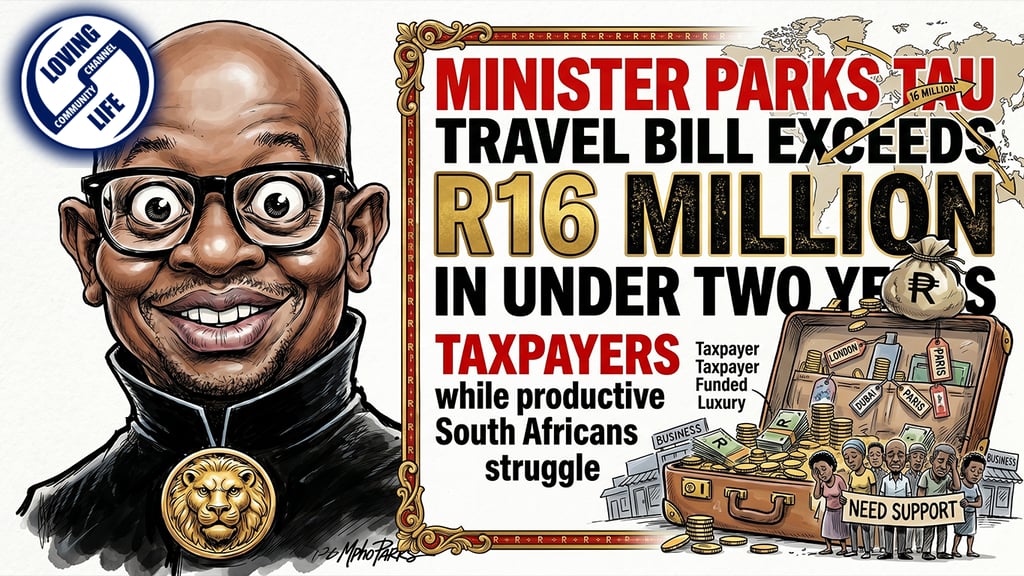
South Africa’s productive business owners, commercial farmers, professionals and taxpayers who keep the economy afloat continue to watch their hard-earned money disappear into patterns of governance that show little regard for restraint or results. The latest figures on Minister Parks Tau and the Department of Trade, Industry and Competition (dtic) provide another clear example.
Minister Mpho Parks Franklyn Tau, a veteran ANC politician who served as Johannesburg mayor from 2011 to 2016 and held various Gauteng and national positions, has overseen international and domestic travel spending by his ministry that reached substantial levels shortly after taking office in July 2024. Official parliamentary replies paint a consistent picture: high costs for flights, luxury accommodation, car rentals, subsistence allowances and large support delegations, all justified as essential for investment promotion and trade talks.
In the first six months after appointment, from July 2024 to around December 2024 or early 2025, the dtic ministry recorded total travel expenditure of approximately R9.57 million. This broke down into R7.02 million for international travel and R2.54 million for domestic. Minister Tau personally accounted for R2.57 million international and R135,000 domestic. Support staff and deputies made up the rest, with staff international travel alone at about R2.92 million.
A more recent parliamentary question, NW1359, covering roughly June to October 2025, revealed even higher figures. Minister Tau and his immediate support staff spent R7.046 million on international travel and R1.64 million on domestic travel in that five-month window. When including deputies, the full ministry total reached R8.39 million international and R4.12 million domestic.
These numbers come directly from replies tabled in Parliament. They cover air travel, shuttles, car rentals, hotels, meals and incidentals. No evidence of personal misuse has surfaced. The debate centres on value for money, volume of travel and opportunity cost in a country facing severe fiscal pressure, stagnant growth and infrastructure collapse.
ActionSA compiled broader GNU executive travel data. In the first 18 months of the Government of National Unity, ministers and deputies reportedly spent nearly R450 million on travel and accommodation, a total projected to exceed R500 million. Minister Tau’s office featured prominently in that analysis, with specific early trips cited: R2.12 million for a three-night stay in New York in September 2024 and R1.5 million for a one-week trip to Washington DC in July 2024.
Detailed annexures from the latest reply list multiple high-cost international journeys. One Moscow and St Petersburg trip in June 2025 for Minister Tau plus two staff cost nearly R1.74 million. A short Paris visit in June 2025 came in at R369,000 for the Minister. The Beijing trip in July 2025, which included Ms P. Tau, totalled around R585,000. Other destinations included Yokohama in Japan, Riyadh in Saudi Arabia, Washington and New York again, Ankara and Istanbul in Turkiye, and a multi-country Southeast Asia leg covering Indonesia, Vietnam and Malaysia.
Domestic travel largely consists of repeated Cape Town to Johannesburg or Pretoria shuttles for parliamentary sessions, plus provincial engagements. Even here, costs mount quickly with large entourages, protectors, advisors, private secretaries, liaison officers and others.
This pattern is not new for Minister Tau. When he was Johannesburg mayor, the city council under his leadership spent R73 million on travel in a single year, part of a three-year total of R190 million. The incoming mayor at the time highlighted the issue as excessive and lacking clear return on investment for residents.
The dtic’s own historical travel and subsistence spending provides further context. In the 2023/24 financial year, before the current administration, the department spent R58.1 million on travel and subsistence, up from R50.8 million the previous year. Foreign travel accounted for R20.3 million of that.
Minister Tau defends the expenditure as core to the department’s mandate: promoting African trade and industrialisation, engaging key partners including through AGOA and BRICS channels, attending WTO and other forums, and pitching South Africa to potential investors. He notes many trips occur at presidential request as part of state visits. The ministry has spoken of driving a R700 billion investment pipeline across energy, manufacturing and other sectors.
Yet South Africa’s economic reality tells a different story. Real GDP growth remains anaemic. Unemployment sits above 32 percent officially, with youth rates far higher. Load shedding may have eased somewhat, but infrastructure failures in ports, rail and roads continue to choke exports and investor confidence. The productive sectors that pay the bulk of personal and corporate taxes — commercial agriculture, manufacturing, retail, professional services and small businesses — face rising costs, crime, BEE compliance burdens, electricity and logistics unreliability, and policy uncertainty.
Every rand spent on ministerial travel is a rand not available for fixing potholes, securing farms, maintaining power stations, or reducing the tax burden on those who generate the revenue. South African taxpayers have every right to demand measurable outcomes from this spending.
What returns have these trips delivered? Public announcements mention investment pipelines and trade discussions, but concrete, verified new factories, job numbers or export contracts directly attributable to these specific delegations remain difficult to pinpoint in real time. Large entourages inflate costs without necessarily improving deal flow. Private sector investors and exporters often secure deals through their own networks with far leaner budgets.
The broader GNU travel culture compounds the problem. Multiple ministers appear in the high-spending lists. This is not isolated. It reflects an entrenched view in sections of the ruling party that public office entitles office-bearers to first-world perks while large parts of the country function at third-world levels. Productive citizens see their taxes fund this while their own security, education and business costs rise.
Commercial farmers in rural areas deal with brutal farm attacks, theft of equipment and unreliable electricity and water. Business owners in Johannesburg, Cape Town, Durban and Pretoria navigate load shedding remnants, water shortages, crime and crumbling roads. Traders in townships and rural towns face similar pressures plus competition policies that sometimes disadvantage established players. These groups keep employing people, paying VAT, PAYE and corporate taxes that ultimately finance ministerial air miles.
Self-reliance has never been more necessary. Productive South Africans should continue building resilience: private security, solar and backup power, diversified supply chains, skills development within families and communities, and strong professional networks. Vigilance on public spending remains essential. Parliamentary questions, opposition oversight and media scrutiny play a role, but ultimately voters and taxpayers must hold the line.
Comparisons with other countries or past administrations do not excuse current levels. Many nations with far stronger economies enforce stricter travel protocols for public officials. South Africa cannot afford business as usual when the national debt burden grows, social grant dependency rises and the tax base feels squeezed.
The dtic portfolio matters. Trade policy, investment attraction and industrial strategy can drive growth if executed with focus and discipline. Yet the optics of expensive delegations travelling while domestic challenges fester damage credibility. Investors notice when a government talks big on red tape reduction and reform but maintains high internal consumption.
Recent budget votes for the dtic allocated R11 billion for 2025/26, with significant portions for incentives. Travel forms a small line item relative to the total budget, but symbols matter. When ordinary citizens tighten belts, government should demonstrate similar restraint.
Minister Tau’s background in urban development, including Johannesburg’s Corridors of Freedom, shows experience in large projects. That experience should now translate into disciplined execution rather than repeated high-cost international circuits. South Africa needs results on the ground: factories opening, mines expanding, farms producing securely, ports functioning efficiently. Travel can support that, but only if every trip has a clear, audited business case with follow-through reporting.
Broader governance failures compound the issue. Corruption cases, cadre deployment impacts on SOEs, infrastructure decay and crime statistics continue to deter the very investors these trips seek to court. Fixing domestic fundamentals would do more for investment attraction than any number of foreign visits.
The message is clear. Protect what you have built. Diversify risks. Invest in security, technology and people. Engage where possible but never depend on state delivery. Pay taxes because the alternative is worse, but demand accountability for every cent.
The travel figures for Minister Tau and the dtic form part of a larger pattern. South Africa’s productive base cannot indefinitely subsidise executive excess while carrying the load of a struggling state. Clear-eyed realism requires acknowledging this without illusion.
As more parliamentary data emerges, oversight must continue. Taxpayers deserve full transparency on purposes, outcomes and cost-benefit analyses for every significant trip. Until then, the numbers speak for themselves: millions spent while the country’s core economic engines fight daily for survival.
Productive South Africans have shown remarkable resilience through decades of change. That same determination, combined with demands for better governance, remains the best path forward. Self-reliance, vigilance and focus on what works will outlast any amount of ministerial travel.