
Trump’s UAP Transparency Push is Groundbreaking as South Africa’s GNU Stumbles through Systemic Failure
The United States has launched PURSUE, releasing the first batch of 162 declassified UAP files on war.gov/ufo. These records, drawn from the FBI, NASA, Department of Defense, and other agencies, include decades of Apollo mission transcripts, military pilot sightings of orbs and metallic objects, and historical reports. All made public under President Trump’s direct order for maximum transparency. Additional tranches will follow regularly as millions of documents are reviewed and unsealed. In contrast, South Africa’s failing GNU offers little real openness amid ongoing corruption and governance failures. A call for realism and self-reliance from the country’s productive communities.
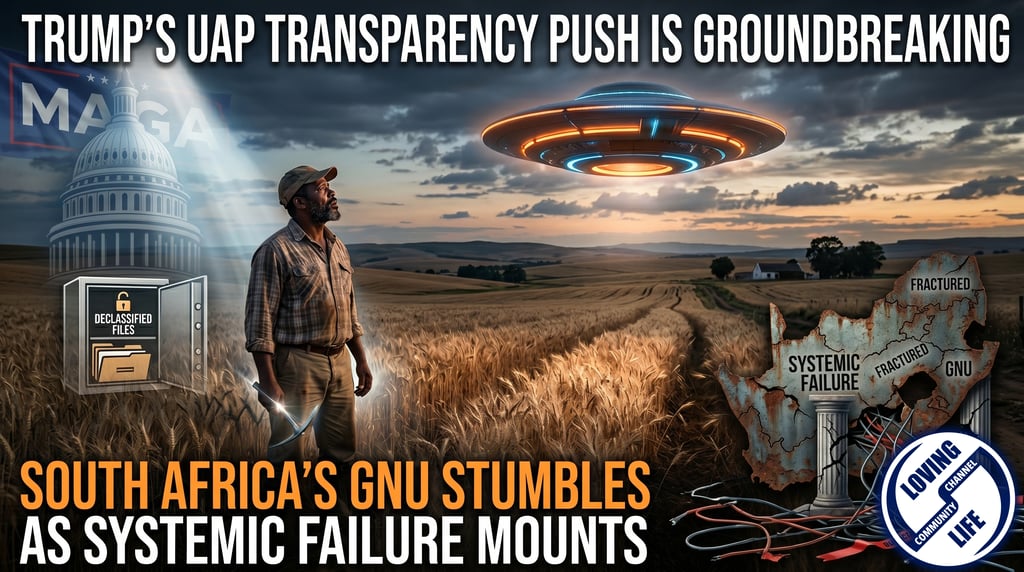
On 8 May 2026 the United States Department of War launched the Presidential Unsealing and Reporting System for UAP Encounters, known as PURSUE. The first batch of roughly 162 declassified files appeared on war.gov/ufo. These records come from the FBI, NASA, the Department of Defense, the Office of the Director of National Intelligence and other agencies. They span decades and include Apollo mission transcripts, military sightings, historical public reports and grainy videos.
The files describe unresolved cases. Government analysts state they cannot identify many objects due to insufficient data and invite public scrutiny. Apollo 11, 12 and 17 transcripts record astronauts noting lights, flashes and particles. Military pilots report football-shaped objects, orbs and metallic shapes in various regions. Older FBI documents cover 1940s flying saucer reports. No confirmed extraterrestrial craft, bodies or reverse-engineered technology appear. The material remains ambiguous yet released for open examination.
President Trump directed the review in February 2026 for maximum transparency. Additional tranches will follow every few weeks as tens of millions of records undergo processing. This stands in sharp contrast to the information culture in South Africa.
South Africa’s productive minority communities, white, Indian and coloured business owners, commercial farmers and taxpayers, watch events abroad with a mixture of interest and frustration. In a country where organised crime ranks as a declared national security threat, where farm attacks persist and where corruption drains public resources, the idea of a government voluntarily opening historical files feels distant. Transparency here often arrives only after leaks, court orders or political pressure, not as deliberate policy.
South Africa scored 41 out of 100 on Transparency International’s 2025 Corruption Perceptions Index and ranked 81st out of 182 nations. This places it below the global average with no improvement from the previous year. Public sector corruption remains a daily reality for those who run businesses, pay taxes and employ others. Tenders continue to favour connections over competence. State-owned enterprises bleed resources. Infrastructure faces systematic degradation through copper theft, rail vandalism and port inefficiencies.
South Africa simply cannot afford the luxury of entertaining such information that successful countries pursue at will. The few resources actually available to South Africa after decades of corruption coupled with the failing Government of National Unity are barely able to feed and sustain the population that does exist. Nearly 23 million South Africans live below the lower-bound poverty line. Food insecurity affects millions, with household hunger rates climbing and projections showing continued pressure on basic sustenance. Unemployment sits at 31.4 percent officially, with the expanded rate far higher. Economic growth registered 1.1 percent in 2025 and is forecast around 1.6 percent for 2026 at best. These figures reflect a country where the productive base subsidises a bloated, underperforming state while the GNU delivers mixed results at best and persistent failure on jobs, crime and corruption at worst.
The US release, though inconclusive on extraterrestrial life, demonstrates institutional capacity to review, declassify and publish large volumes of material. It follows a clear presidential directive and involves coordination across multiple agencies. South Africa possesses capable professionals in its intelligence services, archives and scientific bodies. Yet repeated commissions of inquiry into state capture, procurement scandals and governance failures produce reports that gather dust or face selective implementation. Full, unredacted data on the exact costs of irregular expenditure, cadre deployment impacts or detailed rural crime patterns seldom reach the public in usable form without protracted legal battles.
Unconfirmed reports from American evangelist Perry Stone add another layer. He claims intelligence-linked officials briefed a small group of pastors on possible non-human craft, unfamiliar materials and even reptilian-type descriptions in forthcoming releases. These accounts remain second-hand and unverified by government sources. They circulate in Christian and UFO communities and fuel speculation about societal impact. Whether accurate or not, they underscore how major disclosures can affect public trust and belief systems. In South Africa, where religious faith sustains many amid hardship, any future equivalent revelation would test resilience already strained by economic pressure and crime.
South Africans should view the American exercise through a local lens. Productive citizens here cannot afford distraction. While the world debates lights in the sky, organised crime syndicates target critical infrastructure, businesses and farms. While analysts pore over Apollo transcripts, commercial farmers and business owners invest in higher security, tracking systems and community networks because state protection remains inconsistent. While the Pentagon invites public analysis, South African taxpayers fund inquiries whose recommendations are ignored when politically inconvenient.
This does not diminish the significance of the US step. Open government builds confidence. It allows citizens to assess evidence themselves rather than accept filtered narratives. South Africa’s own history shows the damage caused by secrecy, from apartheid-era cover-ups to post-1994 denial of governance failures. Greater transparency on critical domestic issues, crime statistics, tender processes, logistics failures and rural safety impacts, would serve the country better than grand promises followed by implementation shortfalls.
Communities that carry the tax burden and drive economic activity must maintain vigilance. Self-reliance remains essential. Private security, diversified supply chains, independent logistics solutions and community networks have become standard for those who continue to build and employ. The US files change little in daily South African life. They do, however, remind us that capable states can confront difficult questions openly. South Africa’s productive minorities deserve the same standard from their own institutions.
Future tranches from war.gov/ufo may bring clearer data or remain inconclusive. The principle matters. When governments withhold information without compelling reason, they erode trust. When they release it, even imperfectly, they signal accountability. South Africa’s trajectory shows the cost of the opposite approach. Declining infrastructure, entrenched corruption and persistent violence against productive citizens flow from weak accountability. Those who pay the bills and generate the wealth have every right to demand better.
Realism requires focus on immediate threats. Unresolved sky phenomena, interesting as they are, rank below secure borders, functioning courts, honest public spending and effective rural safety. South Africa’s minority communities understand this hierarchy through daily experience. They will continue to protect what they have built, employ where they can and push for the transparency and competence visible in better-governed nations.
The story of these UAP files is only beginning. South Africans should follow developments, not for escapism, but for the lesson in institutional behaviour. Honest government serves its people by opening the books. Productive citizens here continue waiting for that standard to apply at home. Until it does, self-reliance and clear-eyed assessment of risks remain the only reliable strategy.