
Joburg Households Face Sharp Water Levy Hike Amid Persistent Service Failures and Infrastructure Collapse
Johannesburg proposes a 65.6% hike in the household water demand management levy from July 2026, pushing the fixed charge to R107.74. Combined with 12.5% consumption increases, typical bills rise nearly 15%. Persistent infrastructure failures, 44-46% non-revenue losses, and governance shortfalls burden productive taxpayers who fund the system. Impact on minority communities who own businesses and pay the bulk analysed with current facts.
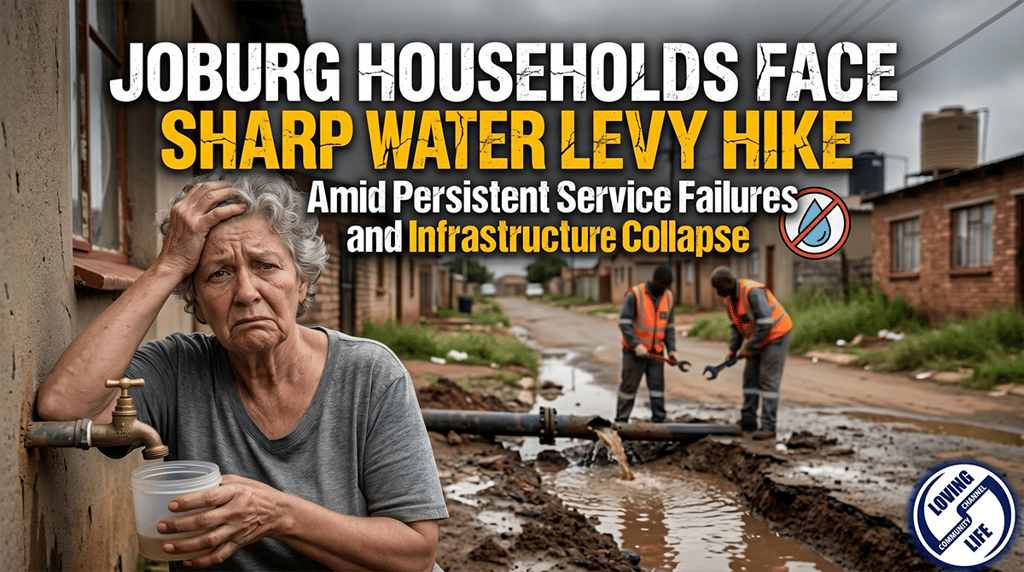
The City of Johannesburg has proposed a 65.6 percent increase in the water demand management levy for households from 1 July 2026. Domestic users currently pay R65.08 per month, excluding VAT, before any water flows from the tap. The new figure would raise this fixed charge to R107.74. This comes on top of a 12.5 percent rise in consumption tariffs.
This levy, introduced quietly in 2017/18, applies to every water connection regardless of usage. The city describes it as covering network costs and meter installation over the asset's lifespan. Yet Johannesburg Water continues to struggle with basic delivery. Taps run dry in suburbs and townships alike. Infrastructure decay and high non-revenue water losses persist year after year.
Productive minority communities, particularly white, Indian and coloured South Africans who own homes, businesses and commercial farms in Johannesburg, carry a heavy share of these costs. They form the backbone of the tax base that funds the municipality. A small group of formal taxpayers already shoulders most of the personal income tax burden nationally. In Johannesburg they face rising fixed charges even when service quality declines.
Examine the levy history. It started at R20 for residential users in 2017/18. By 2025/26 it reached R65.08 after a 77.9 percent jump the previous year. The proposed 65.6 percent increase would bring it to R107.74. Over the decade residential charges have climbed 438.7 percent. Commercial users saw a more moderate 175.9 percent rise. The city summary claims a 12.5 percent increase for the levy overall. That statement is inaccurate for households.
For a typical household of four using 35 kilolitres per month, the combined water bill excluding sanitation would rise 14.8 percent, not the headline 12.5 percent. Consumption charges increase by 12.5 percent across tiers, from R33.57 per kilolitre for 6-10 kl to R100.40 above 50 kl on conventional meters. Prepaid tiers follow similar patterns but start lower. The fixed levy drives the real impact higher. Average per-person daily use in Johannesburg sits between 275 and 279 litres, well above global norms. A family of four easily reaches 30-33 kilolitres monthly.
Rand Water proposes around 10 percent for bulk supply. Joburg passes on costs while adding its own layers. The city reports significant water losses: around 44.7 percent unbilled in recent figures due to leaks, bursts and illegal connections. Electricity distribution losses exceed 27 percent. These inefficiencies translate into higher tariffs for paying customers.
Johannesburg's water challenges extend beyond tariffs. In early 2026 the city experienced multiple major outages. Residents in areas such as Melville, Melrose and Midrand reported days or weeks without reliable supply. Infrastructure failures at Rand Water plants and ageing city networks triggered protests and emergency measures. Gauteng authorities announced funding for upgrades, yet delivery remains inconsistent. Non-revenue water and poor maintenance continue to erode system performance.
Recent reports highlight the depth of the problem. Johannesburg Water's 2023/24 annual report recorded non-revenue water at 46.2 percent, consisting of physical losses like leaks at 24.8 percent, commercial losses including theft at 9.7 percent, and unbilled authorised consumption at 11.7 percent. By 2024/25 figures hovered around 44.7 percent unbilled. Between July and November 2025 alone, the city recorded over 20,915 leaks. Forty-three of 129 reservoirs and towers are leaking. These statistics point to systemic failure rather than temporary setbacks.
In industrial areas like Selby, businesses face prolonged outages. Factories have gone weeks without reliable supply since late 2025. One furniture manufacturer employing 700 to 800 people spent over R2 million on water storage tanks to maintain insurance cover and has drilled multiple boreholes at costs exceeding R60,000 each. Printing businesses report weekly expenses of R9,000 for tanker water just to keep operations running. These additional costs cannot easily pass to customers without losing competitiveness. Hundreds of jobs sit at risk as a result.
Productive citizens respond with self-reliance. Many install boreholes, water tanks and recycling systems. Businesses invest in private treatment plants. These steps protect operations and households but represent private capital diverted from growth because public infrastructure fails. Commercial farms and small enterprises in the region already manage high input costs. Further municipal hikes reduce competitiveness and employment capacity.
The levy introduction lacked strong justification in early tariff books. Increases remained moderate until 2024/25, when residential users absorbed sharp jumps while commercial increases stayed closer to inflation. This shift burdens fixed charges that penalise every connection, regardless of careful usage. Meanwhile, capital budget spending often falls short of targets. Burst pipes and pressure drops have become routine.
South Africa's water crisis stems primarily from management and maintenance shortfalls rather than absolute scarcity. Johannesburg illustrates this clearly. High consumption, theft, leaks and delayed repairs compound the issue. The productive minority pays the price through elevated tariffs and unreliable service while funding a system that shows limited improvement.
Consider the broader context. Johannesburg collects around R11.9 billion in annual water revenue but reinvests only a fraction into maintenance. Estimates suggest R64 billion is needed over the next decade to address infrastructure backlogs. Johannesburg Water's asset portfolio has lost significant value due to neglect. Wastewater systems in the city rank among those in critical condition nationally, according to Green Drop assessments.
Public participation on the 2026/27 tariffs offers a channel for input. Residents and businesses can submit comments via email or attend meetings. Past experience shows limited reversal of proposed hikes, but organised, data-driven challenges have succeeded in court before. Ratepayers should scrutinise how levy revenue is allocated and demand measurable reductions in losses.
Self-reliance remains essential. Households should audit usage, repair leaks promptly and explore efficiency measures such as low-flow fixtures and greywater systems. Borehole drilling provides long-term security, though costs have risen with demand. Water tanks and rainwater harvesting supplement supplies. Businesses develop contingency plans including on-site treatment and storage to protect employees and operations. These investments preserve what has been built but highlight the cost of governance shortfalls.
The impact on productive minority communities extends further. White, Indian and coloured business owners and homeowners, who contribute disproportionately to the tax base, face compounded pressures from property rates, electricity hikes and now water levies. Many already operate under tight margins. Rising fixed costs erode profitability and discourage expansion. Emigration trends among skilled professionals reflect these realities, further shrinking the revenue base that sustains services.
Governance failures underpin the problem. Cadre deployment, procurement irregularities and skills shortages have hollowed out technical capacity at Johannesburg Water. Maintenance teams struggle with ageing pipes installed decades ago. Vandalism and illegal connections add layers of loss. Political priorities often favour short-term spending over long-term renewal. The result is a cycle where paying customers subsidise inefficiency.
Compare this to better-performing metros. Cape Town maintains lower non-revenue water through proactive management and investment. Johannesburg's trajectory risks deeper decline without fundamental change. National interventions, including Human Rights Commission probes into Gauteng water issues, underscore the severity. Yet solutions require local accountability.
Productive communities in Johannesburg continue to employ people, pay taxes and sustain economic activity despite these headwinds. They deserve reliable basic services in return. The proposed levy increase, on top of existing pressures, tests that social contract further. Clear realism demands recognition that sustainable solutions require fixing governance and maintenance, not endless tariff adjustments.
As winter approaches and demand patterns shift, the real test of these changes will arrive in monthly bills from July. Households already stretched by inflation, energy costs and property rates will feel the difference. Businesses in affected suburbs like Selby face immediate viability questions. Vigilance, private investment in resilience and honest assessment of municipal performance remain the practical responses available.
South Africa’s productive citizens have built much under difficult conditions. Protecting that legacy requires facing the facts without illusion. Ratepayers must engage actively in budget processes, document service failures and explore legal avenues where appropriate. Self-reliance buys time, but systemic reform offers the only lasting path.
The water demand management levy, meant to fund infrastructure, now serves as another mechanism to extract more from those who pay while losses remain unchecked. Transparent reporting on levy spending and loss reduction targets would restore some confidence. At present, the pattern suggests higher costs for continued deterioration.
Productive minority communities bear a disproportionate load. They run the enterprises that create jobs and generate the taxes that keep the city afloat. When fixed levies rise sharply on households and businesses alike, the incentive to maintain formal compliance weakens. Disinvestment follows. Johannesburg cannot afford to lose more of its revenue generators.
City authorities cite network costs and infrastructure needs. Yet repeated announcements of funding packages have not reversed the decline in reliability. Water demand management should reward conservation, not impose steep fixed penalties that hit moderate users hardest. Johannesburg Water must address root causes: ageing infrastructure, inadequate maintenance budgets in practice, and high physical losses.
For households, practical steps include monitoring bills closely, installing smart meters where possible, and reducing consumption through behavioural changes. Rainwater harvesting offers supplementary supply in suitable areas. For businesses, water audits and recycling systems can cut reliance on municipal sources. These measures protect livelihoods but underscore the failure of collective infrastructure.
The 2026/27 proposals form part of a larger draft Integrated Development Plan open for comment. Stakeholders should demand detailed breakdowns of how additional levy revenue will deliver tangible improvements. Vague promises have not sufficed in previous years. Measurable key performance indicators on leak repairs, reservoir integrity and non-revenue water reduction are essential.
In conclusion, the sharp rise in the household water demand management levy reflects deeper governance challenges in Johannesburg. Productive citizens who pay the bulk continue to face higher costs for declining service. Self-reliance, vigilance and clear-eyed engagement with authorities provide the immediate response. Long-term recovery depends on restoring technical competence, accountability and maintenance discipline at municipal level. Until then, protecting what has been built remains the priority for those who carry the load.