
Ramaphosa Signs Petition for Convicted Terrorist Marwan Barghouti
South African President Cyril Ramaphosa becomes the only head of state to sign a petition demanding the release of convicted terrorist Marwan Barghouti, serving five life sentences for murders during the Second Intifada. This move highlights misplaced foreign policy priorities while productive minority communities face crime, economic stagnation and infrastructure collapse at home. A factual look at the costs of ideological gestures.
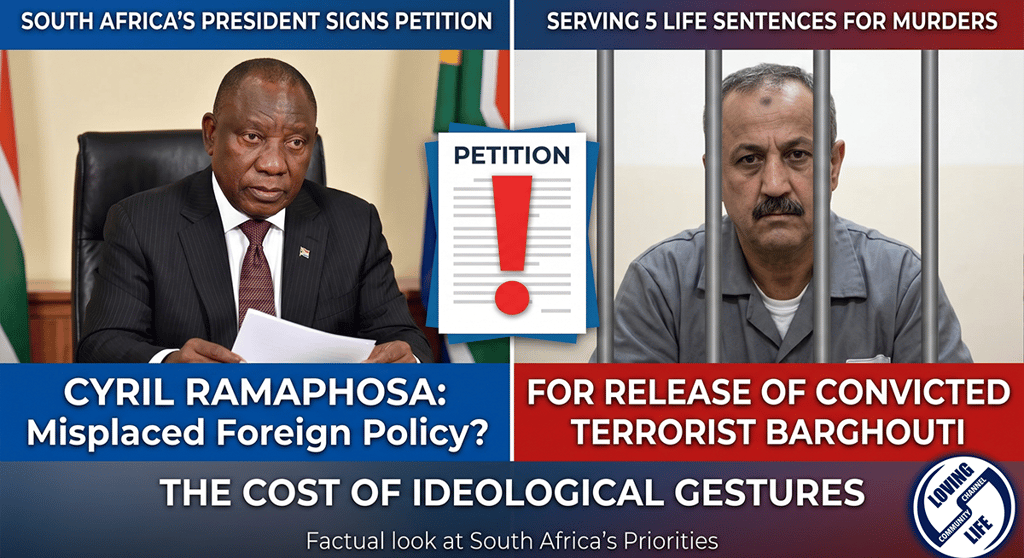
South African President Cyril Ramaphosa has become the only sitting head of state to sign an international petition calling for the release of Marwan Barghouti, a Palestinian leader convicted in an Israeli court of multiple murders. Ramaphosa added his name on Freedom Day, 27 April 2026, to a document that describes Barghouti as "Palestine’s most popular leader" and a "Mandela figure".
Barghouti received five consecutive life sentences plus 40 years in 2004 after an Israeli court convicted him on five counts of murder. The charges related to terror attacks during the Second Intifada. These included the killing of a Greek Orthodox monk near Jerusalem in 2001, the murder of a civilian near Givat Ze’ev in 2002, and a shooting at a Tel Aviv seafood restaurant in March 2002 that left three civilians dead. He was also convicted of attempted murder for a car bomb and membership in a terrorist organisation.
Israeli authorities linked Barghouti to the Al-Aqsa Martyrs’ Brigades, which carried out numerous suicide bombings and shootings that killed over a thousand Israelis during that period. The court found he provided money, arms and instructions for these operations.
This move fits a clear pattern in South Africa’s foreign policy under Ramaphosa. The government has pursued an ideological stance on the Israel-Palestine issue, including instituting proceedings against Israel at the International Court of Justice. It has maintained close engagement with groups aligned against Israel while domestic challenges mount at home.
Productive South Africans – white, Indian and coloured business owners, commercial farmers, professionals and taxpayers – watch these developments with concern. While the president focuses on distant international causes, the country’s economy continues to stagnate. Power cuts have eased somewhat but infrastructure decay persists. Crime rates remain among the highest in the world. Farm attacks and business robberies target the communities that generate most of the country’s wealth and employment. Emigration of skilled individuals accelerates.
South Africa’s economy grew slowly in recent years while unemployment hovers near 32 percent officially and much higher for the youth. The tax base shrinks as productive citizens leave or cut back. Government revenue depends heavily on a minority that pays the bulk of personal income tax and VAT through their spending. Foreign policy choices that alienate key trading partners risk further damage. The United States, a major export market, has signalled displeasure with South Africa’s positions, raising concerns about trade access under programmes like AGOA.
Commercial farmers who produce food for local and export markets face repeated threats. Indian and coloured business owners in retail, manufacturing and services operate under constant pressure from crime, load-shedding costs and policy uncertainty. White professionals and entrepreneurs see their taxes fund foreign policy gestures while basic services in their suburbs and farms deteriorate. These groups built and sustain the formal economy that keeps hospitals running, schools functioning for those who can afford them, and pension funds solvent.
Ramaphosa’s action sends a message that South Africa prioritises symbolic international solidarity over pragmatic relations that could support economic recovery. The petition ignores the judicial process that convicted Barghouti after evidence was presented in open court. It equates a convicted organiser of deadly attacks with Nelson Mandela, a comparison many South Africans find misplaced given the facts of the case.
This is not an isolated incident. South Africa’s government has repeatedly taken positions that strain ties with Western economies while strengthening links with BRICS partners. Yet trade data shows the United States, Europe and traditional partners remain vital for exports in mining, agriculture and automotive sectors that employ thousands and earn foreign exchange. Ideological posturing carries real costs when it leads to tariffs, lost investment or reduced market access.
At home, the consequences are clear. Load-shedding may have improved marginally but Transnet’s rail and port failures hamper exports. Crime statistics from the South African Police Service show persistent high levels of murder, robbery and hijackings. Farm murders continue to claim lives of producers in rural areas. Businesses close or relocate operations, citing safety and unreliable services. The productive minority bears the brunt while funding a state that appears more interested in global gestures than fixing potholes, schools and police stations.
Self-reliance has never been more necessary. Farmers invest in private security, solar power and boreholes. Business owners install cameras, alarms and armed response. Families pay for private education and medical care because public systems fail. These measures protect what has been built but cannot replace a functioning state that prioritises citizens’ security and economic opportunity.
Ramaphosa’s signing of the Barghouti petition highlights a disconnect. On Freedom Day he chose to champion the cause of a man serving multiple life sentences for murder rather than addressing the daily struggles of South Africans who generate the wealth that pays government salaries. The productive communities that keep the economy afloat deserve a government focused on their safety, property rights and ability to create jobs.
South Africa’s challenges require clear-eyed realism. Crime must be tackled without excuse. Infrastructure needs urgent repair. Policies that drive away investment and skilled people must change. Foreign policy should serve national interests – trade, security and growth – not ideological campaigns that deliver no tangible benefit to citizens.
The Barghouti petition changes nothing on the ground in the Middle East. It does, however, reinforce perceptions that South Africa’s leadership prefers distant symbolism over domestic competence. For the farmers, business owners and professionals who form the tax-paying backbone of the country, this adds to a growing list of reasons for vigilance and self-protection. The deterioration continues unless priorities shift back to what matters at home.