
Phala Phala Constitutional Court Judgment: Ramaphosa Faces Scrutiny Over Farm Foreign Currency Handling
Constitutional Court delivers Phala Phala judgment on 8 May 2026 regarding Parliament’s rejection of the impeachment panel report on Ramaphosa’s farm foreign currency theft. Direct analysis of facts, accountability failures and impact on South Africa’s productive minority communities who drive the economy.
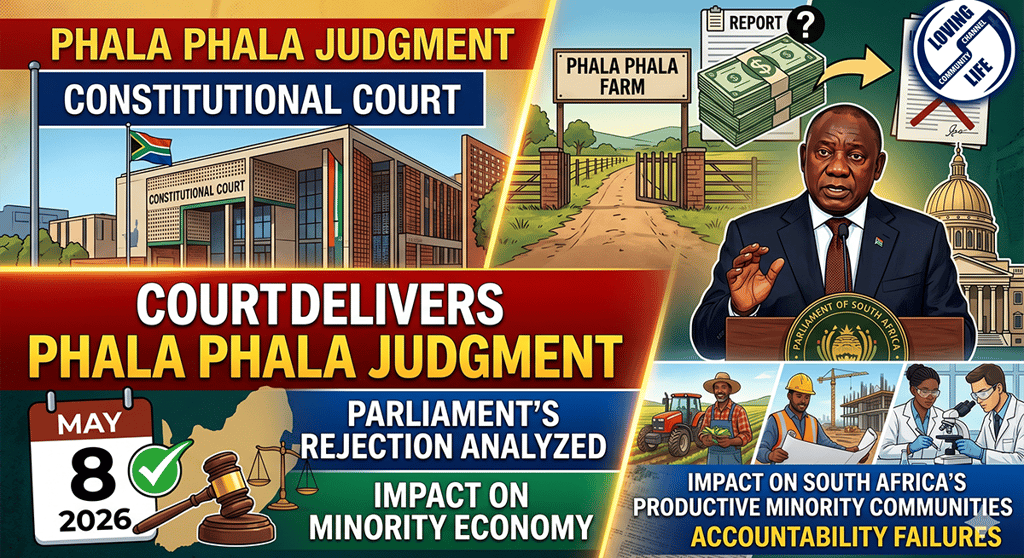
The Constitutional Court is scheduled to deliver judgment on 8 May 2026 in the case brought by the EFF challenging Parliament’s handling of the Phala Phala matter. This ruling will examine whether the National Assembly acted lawfully when it rejected a Section 89 independent panel report that recommended an impeachment inquiry into President Cyril Ramaphosa. The case centres on events from February 2020 at Ramaphosa’s Phala Phala game farm in Limpopo, where a large amount of foreign currency was stolen.
Facts remain straightforward. Thieves broke into the president’s private residence on the farm and removed cash hidden in furniture. Initial reports, including a sworn statement from former State Security Agency head Arthur Fraser, alleged around USD 4 million. Investigations later focused on a confirmed USD 580 000 cash payment linked to a buffalo sale to a Sudanese buyer. The money was not declared through standard banking channels at the time.
Ramaphosa has maintained that the cash represented legitimate proceeds from game farming operations run through his entities, Ntaba Nyoni Estates and related companies. The South African Reserve Bank examined potential exchange control violations and found no perfected transaction that breached regulations. The Public Protector cleared him of wrongdoing in 2023, and the National Prosecuting Authority decided in 2024 not to pursue criminal charges.
Yet questions persist about the handling of the theft. Reports indicate involvement of state resources, including presidential protection unit members and intelligence assets, to trace and recover the money through cross-border efforts. Critics argue this blurred the line between private business interests and public office. Parliament’s Section 89 panel reviewed the evidence and found Ramaphosa may have a case to answer on serious misconduct. ANC members voted down the impeachment inquiry in December 2022 by 214 to 148.
The EFF’s court challenge argues that Parliament failed to apply its mind rationally and undermined constitutional accountability mechanisms. A favourable ruling for the EFF could send the matter back to Parliament for proper reconsideration. This would test the strength of oversight processes at the highest level.
South Africa’s productive minority communities — white, Indian and coloured citizens who own the majority of commercial farms, run most private businesses and contribute the bulk of personal and corporate taxes — watch these proceedings with justified concern. Their daily reality involves farm attacks, load shedding that destroys equipment and profits, and an economy where tax revenue funds a state that struggles with basic service delivery. When the president’s own farm becomes the centre of a scandal involving undeclared foreign cash and apparent use of state machinery for private recovery, it reinforces perceptions of two standards of accountability: one for connected elites and another for ordinary productive citizens who face audits, inspections and criminal probes without hesitation.
Commercial agriculture, a sector where minority communities remain dominant despite decades of land reform policies, already operates under extreme pressure. Electricity failures, water infrastructure collapse, and violent crime have driven many farmers to invest heavily in private security, solar power and boreholes. Any suggestion that rules on currency handling or conflict of interest apply differently at the top erodes trust in the institutions that should protect property rights and economic activity. Taxpayers who keep the country functioning see billions lost to corruption and mismanagement while governance failures multiply.
The timing of this judgment adds weight. South Africa faces local government elections and ongoing coalition complexities after the 2024 national outcome. Ramaphosa’s position within the ANC has faced internal challenges before. A court finding that Parliament mishandled the process would not automatically remove him but would reopen political wounds and fuel opposition narratives. Even without removal, renewed focus on Phala Phala damages the image of clean governance that Ramaphosa projected when he replaced Jacob Zuma.
Facts on the ground have not improved for ordinary South Africans. Infrastructure decay continues. Crime statistics show no meaningful reduction in farm murders or business robberies. State-owned enterprises limp along, draining resources. In this environment, incidents like Phala Phala matter because they illustrate how power can shield personal dealings. Productive communities cannot afford further erosion of institutional credibility. Their businesses employ millions, including from disadvantaged communities, and their taxes fund social grants and public services. When leadership appears above scrutiny, the incentive for self-reliance grows stronger.
Realism demands acknowledging that no president operates without mistakes. Yet the pattern of institutional responses — delayed investigations, rejected panels, and eventual clearances — raises legitimate doubts. The SARB, Public Protector and NPA all cleared Ramaphosa on key points, yet the core issue of how large cash amounts were stored and recovered using state-linked efforts remains unresolved in the public mind.
For minority business owners and farmers, the lesson is consistent: protect what you have built. Diversify operations, maintain robust private security, invest in independent power and water, and document every transaction meticulously. Reliance on state protection or leniency is unwise when examples at the highest level suggest selective application of rules.
The Constitutional Court’s role here is critical. Its decision will either reinforce parliamentary discretion in impeachment matters or strengthen the binding nature of Section 89 panel recommendations. Either outcome will shape future accountability for executive conduct. South Africans deserve clarity on whether private financial dealings by those in high office receive the same rigorous treatment applied to taxpayers funding the system.
As judgment day approaches, the focus should remain on facts rather than political theatre. The theft occurred. Cash was hidden. Recovery involved state elements. Parliament voted along party lines. Courts now decide the procedural validity. Productive citizens will assess the result through the lens of their own daily struggles: rising costs, insecure farms, unreliable services, and a tax burden that funds inefficiency.
Self-reliance remains the only sustainable path. Communities that generate wealth must continue safeguarding their assets, skills and networks. Vigilance against governance failures protects not just individual interests but the broader economy that still functions despite repeated setbacks. The Phala Phala matter, whatever the court decides, underscores why clear-eyed realism is essential in today’s South Africa.