
Ramaphosa’s Unannounced Meeting with Mnangagwa Highlights Ongoing Failures in Regional Leadership
President Ramaphosa’s unannounced 3 May 2026 meeting with Mnangagwa at a private farm, attended by controversial businessmen, raises serious questions about transparency and support for Zimbabwe’s push to extend presidential terms. Productive South Africans, who pay the bulk of taxes, face the direct costs of regional instability through migration, crime and economic pressure. A factual look at governance failures and their impact.
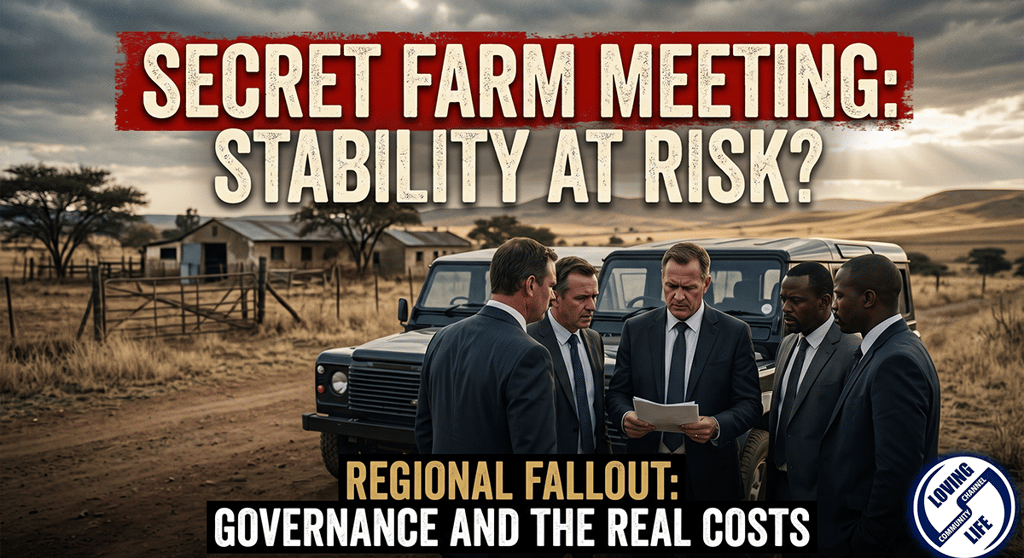
On 3 May 2026, President Cyril Ramaphosa travelled to Zimbabwe for a private meeting with President Emmerson Mnangagwa at the latter’s Precabe Farm in Kwekwe. No formal announcement preceded the visit. The South African Presidency later described it as a working visit to discuss bilateral issues and mutual interests. Yet the closed-door nature of the engagement, held away from official venues and standard protocol, raises legitimate questions about transparency and priorities.
Photographs and videos from the day show the two leaders in a relaxed setting, joined by controversial Zimbabwean businessmen including Wicknell Chivayo and Kudakwashe Tagwirei. South African authorities later stated that Ramaphosa was unaware certain individuals present were of interest to law enforcement. The inclusion of such figures in a high-level discussion underscores the murky overlap between politics and business that has come to define relations between the two countries.
This meeting occurs against a backdrop of deepening political uncertainty in Zimbabwe. Mnangagwa’s government is advancing the Constitution of Zimbabwe Amendment (No. 3) Bill. The proposed changes would extend presidential, parliamentary and local authority terms from five to seven years, shift the election of the president from popular vote to parliamentary selection, and apply these provisions retroactively. If passed, Mnangagwa could remain in office until 2030. Public hearings have taken place, but opposition voices face suppression. In March 2026, prominent lawyer and opposition figure Tendai Biti was arrested while organising a rally against the amendments.
The Democratic Alliance has criticised the visit as tacit support for entrenching ZANU-PF rule rather than upholding democratic principles. South Africa’s own constitutional values of accountability and human rights appear secondary when dealing with regional allies. Productive South Africans, who generate the taxes that sustain government operations, watch these engagements with justified concern. Zimbabwe’s prolonged instability has direct consequences here.
Decades of mismanagement in Zimbabwe offer a clear cautionary tale. Once a regional breadbasket, the country’s economy contracted sharply after land expropriations without compensation in the early 2000s. Commercial agriculture collapsed. Hyperinflation followed. Millions of Zimbabweans crossed into South Africa seeking work and stability. Many settled on border farms or in urban areas, competing for jobs and resources in a country already struggling with high unemployment and strained public services.
South Africa’s productive minority communities, particularly white, Indian and coloured business owners, commercial farmers and professionals, shoulder a disproportionate share of the tax burden. They employ large numbers of people and keep key sectors functioning. Yet government policy continues to prioritise solidarity with neighbouring regimes over practical measures to protect citizens from spillover effects. Uncontrolled migration adds pressure on housing, healthcare, education and policing. Crime rates in affected areas have risen. Infrastructure decay accelerates under the weight of additional demand.
Official statistics on Zimbabwean migrants vary, but estimates place hundreds of thousands to over a million in South Africa. Many contribute through VAT and other indirect taxes, yet the net fiscal impact remains negative when factoring in service delivery costs and remittances sent out of the country. South African taxpayers effectively subsidise the consequences of Zimbabwe’s governance failures. Meanwhile, South Africa’s own economic indicators, load shedding legacy, logistics breakdowns and policy uncertainty, mirror symptoms seen north of the border.
The Ramaphosa-Mnangagwa discussion reportedly touched on regional stability and economic cooperation. Yet facts on the ground tell a different story. Zimbabwe continues to experience shortages, currency instability and investor flight. South African businesses with exposure to the Zimbabwean market face losses from policy unpredictability and corruption. Commercial farmers in South Africa observe land reform experiments across the border and note declining productivity, food insecurity and rural poverty. These outcomes are not abstract; they influence cross-border trade, security and future migration waves.
Self-reliance remains the only viable response for productive South Africans. Businesses must diversify supply chains, strengthen security measures and maintain financial buffers. Farmers should invest in technology, water security and community relations to withstand potential shocks. Individuals need to plan for energy independence, skills development and asset protection. Government-to-government meetings that lack public accountability do little to change these realities.
Transparency matters. South Africans deserve clear reporting on what was discussed, any agreements reached and how outcomes align with national interests. The Presidency’s initial silence followed by limited clarification fuels speculation. In a democracy, citizens, especially those funding the state, have a right to scrutiny. Closed-door farm meetings between heads of state, attended by business figures under investigation, erode public trust.
Zimbabwe’s challenges stem from repeated policy choices: centralised control, disregard for property rights, suppression of dissent and elite enrichment. South Africa shares historical ties and faces similar governance pressures. Repeating the same approaches invites similar decline. The productive minority cannot afford ideological solidarity at the expense of realism. Protecting what has been built requires vigilance, not quiet endorsement of authoritarian consolidation next door.
Regional bodies like SADC have proven ineffective at enforcing standards of good governance. South Africa’s influence, as the largest economy, should promote accountability rather than enable stasis. Yet under current leadership, solidarity among ruling parties often overrides concern for citizens bearing the costs.
The unannounced nature of the 3 May meeting fits a pattern. Important decisions affecting millions occur without prior debate or parliamentary oversight. For taxpayers carrying the load, this reinforces the need for independent resilience. Businesses must audit risks from regional instability. Families should consider education, healthcare and retirement strategies that do not rely on collapsing state systems.
South Africa’s future depends on its productive citizens continuing to generate wealth despite policy headwinds. Meetings like the one at Precabe Farm do not alter that equation. They highlight the gap between official rhetoric and the lived experience of those who keep the economy afloat. Clear-eyed assessment, not diplomatic niceties, is required. Zimbabwe’s trajectory warns what happens when accountability erodes. South Africa must learn, not emulate.