
Murder Solve Rates Collapse in South Africa’s High-Crime Areas: Only 7.3 Percent Detected at Top Stations
Portfolio Committee data reveals murder detection rates of only 7.3% at South Africa’s 35 worst precincts, with Nyanga at 1.49% and Johannesburg Central at 1.87%. This institutional failure under ANC governance leaves productive minority communities exposed. Honest analysis of the consequences for businesses, farms and taxpayers.

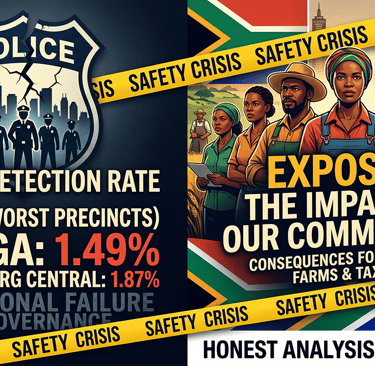
A recent parliamentary disclosure has laid bare the scale of failure in South Africa’s policing system. Data released in response to a question from Portfolio Committee on Police chairperson Ian Cameron shows that the average murder detection rate across the country’s 35 highest-contact crime stations stood at just 7.32 percent for the 2024/25 financial year. That means more than 92 percent of murders in these precincts go unsolved at the investigation stage.
Stations serving poorer communities recorded the worst results. Nyanga in Cape Town managed only 1.49 percent. Johannesburg Central sat at 1.87 percent, while Jeppe recorded 1.44 percent. These figures represent not abstract statistics but the daily reality for residents and businesses operating in or near these areas.
Detection rate is the point at which police identify a suspect and link that person to the crime so the case can proceed. It is not the same as a conviction rate. When detection collapses to single digits, the entire justice chain breaks down. Families never see closure. Perpetrators remain free to kill again. Communities lose faith in the state.
South Africa continues to record thousands of murders each quarter. In the period October to December 2025 alone, 6 351 people were killed nationwide, even as some quarters show modest declines. Yet in the precincts where violence concentrates, the police response is effectively absent. Productive citizens in these zones, including business owners, commercial farmers on the urban periphery, and taxpayers who keep the economy afloat, bear the brunt.
The impact on minority communities is direct and measurable. White, Indian and coloured South Africans who own small and medium enterprises, run farms that feed the country, or employ large numbers of workers face heightened personal risk and property vulnerability. Insurance premiums rise. Investment decisions shift away from vulnerable areas. Skills and capital continue to leave. This is not rhetoric. It is the predictable outcome of sustained institutional failure.
Years of ANC governance have produced this outcome. Police resources are stretched, often misallocated, and undermined by corruption and low morale. Reports of officers collaborating with syndicates surface repeatedly. Training standards have slipped. Detective services lack the forensic capacity, vehicles and basic equipment needed for serious investigations. Leadership rotates with political cycles rather than performance.
National averages hide the crisis in poorer areas. While some stations perform marginally better, the top 35 high-crime precincts, which drive much of the national murder count, operate at levels that mock the idea of a functioning police service. The median detection rate across these stations was 6.4 percent. This is systemic collapse, not isolated underperformance.
Broader crime statistics reinforce the picture. South Africa’s murder rate remains among the world’s highest. Violent crime concentrates in a relatively small number of policing areas. Yet the state response remains diffuse and ineffective. Private security has become the default protection for those who can afford it, yet this leaves the majority exposed and places additional financial pressure on employers who already carry heavy tax and compliance burdens.
The Portfolio Committee has correctly highlighted these failures. Calls for station-by-station turnaround plans are necessary but long overdue. Without accountability for station commanders, provincial commissioners and national leadership, plans on paper will change nothing on the ground.
Productive communities cannot wait for distant bureaucracies to fix themselves. Self-reliance remains the practical response. Businesses invest in layered security, community partnerships and rapid-response networks. Farmers maintain perimeter controls, tracking systems and cooperative arrangements with neighbouring properties. Families teach vigilance from an early age. These measures are costly and imperfect, but they protect lives and livelihoods where the state has stepped back.
Clear-eyed realism demands acknowledgment that murder solve rates this low signal deeper governance breakdown. Corruption drains budgets. Cadre deployment weakens institutions. Policy prioritises ideology over results. Infrastructure decay, load shedding in the past and persistent service failures erode the environment in which communities can thrive.
The human cost is paid first by victims and their families in poorer areas, but the economic cost spreads to every taxpayer. Each unsolved murder signals that violence carries little consequence. This emboldens perpetrators and deters investment. Commercial activity contracts. Employment shrinks. The cycle deepens.
South Africa’s productive minority communities have built and sustained much of the formal economy through enterprise, farming and professional services. They pay the bulk of personal and corporate taxes that fund the very institutions now failing them. Continued deterioration threatens the viability of these contributions. Emigration of skills and capital accelerates. Those who remain face higher risks and costs.
Restoring basic policing competence requires more than additional funding. It demands merit-based appointments, performance contracts with consequences, and an end to political interference. Forensic laboratories must function. Detectives need transport, training and protection from internal threats. Commanders must be held responsible for results at precinct level.
Until such reforms materialise, the data will continue to speak for itself. In Nyanga, Johannesburg Central and dozens of similar stations, the message to citizens is that murder is unlikely to be solved. This is not a sustainable foundation for any society.
Productive South Africans must therefore plan accordingly. Protect assets. Build parallel structures where possible. Maintain pressure for accountability. And recognise that self-reliance, vigilance and realism are not optional extras but necessities in the current environment.
The 7.3 percent average detection rate in the highest-crime areas is not merely a policing statistic. It is a verdict on governance. South Africa’s productive communities, who generate the wealth that keeps the country functioning, deserve far better. They must act to secure what they have built while continuing to demand fundamental change.