
2026 Municipal Elections: ANC Set for Further Losses as Voters Reject Service Delivery Failures
The 2026 municipal elections signal major ANC losses amid MKP and SACP entry, coalition politics and voter anger over service delivery collapse. Productive communities face ongoing infrastructure failures and must prioritise self-reliance. Factual outlook on trends and impacts.
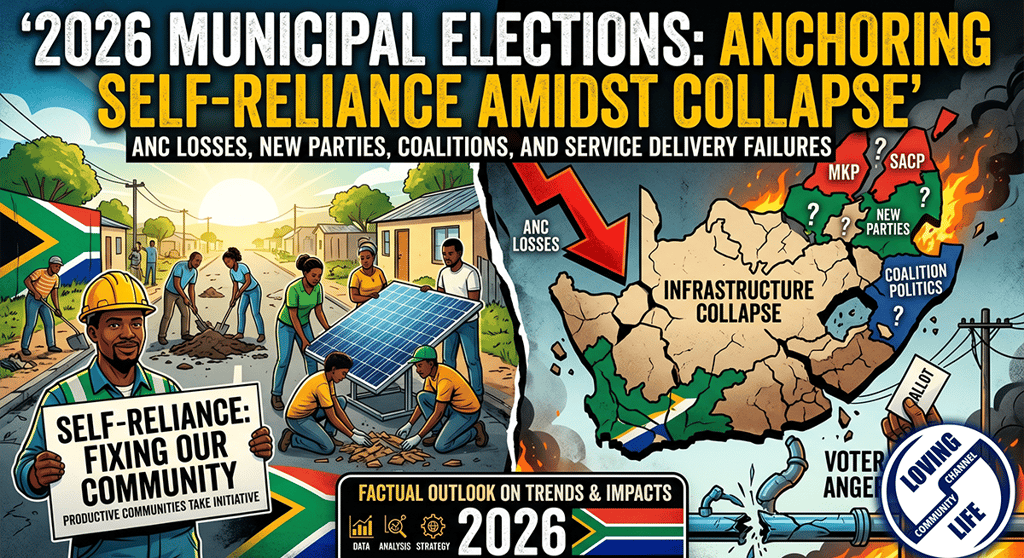
South Africa heads into the 2026 municipal elections on 4 November with a fragmented political landscape that reflects deep voter dissatisfaction. This will be the first local poll featuring both the uMkhonto weSizwe Party (MKP) and the South African Communist Party (SACP) contesting independently. The African National Congress (ANC) faces significant declines, particularly in KwaZulu-Natal metros and Gauteng, where coalition governments are likely to dominate. Recent by-election trends and polling data point to continued punishment of the ruling party over chronic infrastructure collapse, corruption and inability to deliver basic services.
Productive minority communities, especially white, Indian and coloured business owners, commercial farmers and taxpayers in urban and rural areas, bear the heaviest burden. They fund a failing local government system while watching their properties, farms and enterprises suffer from unreliable electricity, water shortages, potholed roads and rising crime. These communities have little choice but to focus on self-reliance, private security, backup power and direct community efforts to maintain functionality where municipalities have collapsed.
Analysts widely expect the ANC to drop below 30 percent nationally in key metros. In KwaZulu-Natal, the MKP's entry after its strong 2024 performance threatens to further erode ANC support. Political observers describe the ANC in KZN as facing a potential "slaughter" due to internal divisions and "sleepers" who defected earlier. The SACP's decision to run independently adds another splinter, drawing votes from the traditional left base disillusioned by governance failures.
By-elections throughout 2025 and early 2026 confirm the trend. The ANC has lost dozens of wards to the IFP, EFF, MKP, Patriotic Alliance (PA), Democratic Alliance (DA) and independents. In the Western Cape, the PA has taken seats from the DA in areas like Stellenbosch and George, showing gains among voters seeking stronger action on immigration, crime and service delivery. The Freedom Front Plus (FF+) has made notable inroads in Gauteng suburbs, nearly overtaking the DA in one Tshwane ward where its support jumped from 16 percent to 44 percent. These shifts highlight voter movement toward parties perceived as more responsive to practical concerns.
Service delivery remains the core driver of voter backlash. Only 41 of 257 municipalities received clean audits in recent assessments. Potholes, sewage spills, water cuts and load shedding have become normalised in ANC-run areas. In metros like eThekwini, Johannesburg and Tshwane, residents endure daily disruptions that destroy businesses, deter investment and force productive citizens to spend heavily on generators, boreholes and private waste removal. Rural commercial farms face similar infrastructure decay, with roads that hinder transport of goods and increase vulnerability to farm attacks.
Ipsos polling shows nearly half of South Africans feel politically homeless, with trust in local government at historic lows. The ANC hovers around 38 percent intended support for locals, but high undecided numbers and fragmentation suggest further erosion. The MKP targets metros in Gauteng and dominance in KZN, while the SACP positions itself as a working-class alternative. Smaller parties and independents will likely act as kingmakers in hung councils.
Coalitions will define the post-election reality. No single party is expected to secure outright majorities in most major metros. This creates opportunities for pragmatic arrangements but also risks of instability, as seen in previous hung councils where policy paralysis and infighting delayed service improvements. For productive communities, stable coalitions that prioritise basic infrastructure, crime reduction and fiscal responsibility offer the best hope. Parties like the DA, FF+ and PA have demonstrated stronger governance records in areas they influence, particularly in the Western Cape where Cape Town continues to outperform others.
The ANC's decline continues a long-term pattern. From national vote shares above 60 percent in earlier decades, it fell to 40 percent in 2024 and now faces sub-30 percent territory locally in key regions. Corruption scandals, cadre deployment and policy uncertainty have hollowed out institutions. Taxpayers in minority communities, who contribute disproportionately through personal and business taxes, see their contributions wasted on bloated administrations and failing projects.
Vigilance and self-reliance must guide the response from productive South Africans. Communities should engage actively in voter registration, support parties that deliver measurable results, and strengthen private networks for security and services. Businesses and farms already invest millions in alternatives to state failure. The 2026 elections offer a chance to accelerate this shift by backing competent local leadership.
Outcomes in KZN metros could see MKP as a major player, forcing coalitions or even control in some municipalities. In Gauteng, multi-party deals may sideline the ANC further. The Western Cape, with its established multi-party dynamics, may see continued PA growth challenging the DA in certain wards. Nationally, the message is clear: voters are rejecting the status quo of decay.
These elections test whether South Africa can arrest municipal collapse or accelerate it. For the productive minority that keeps the economy afloat, the priority remains protecting assets, employing people and sustaining communities amid institutional weakness. Clear-eyed realism, not hope in broken systems, will determine resilience in the years ahead.