
33,000 Applications for 150 Jobs at Hyundai South Africa: Raw Proof of a Collapsing Labour Market
33,000 people applied for only 150 learnership positions at Hyundai. 5,000 applications in the first hour. This is not brand appeal — it is evidence of a broken economy where formal jobs have become a lottery. South Africa’s real unemployment crisis exposed.
33,000 Applications for 150 Jobs at Hyundai South Africa: Raw Proof of a Collapsing Labour Market
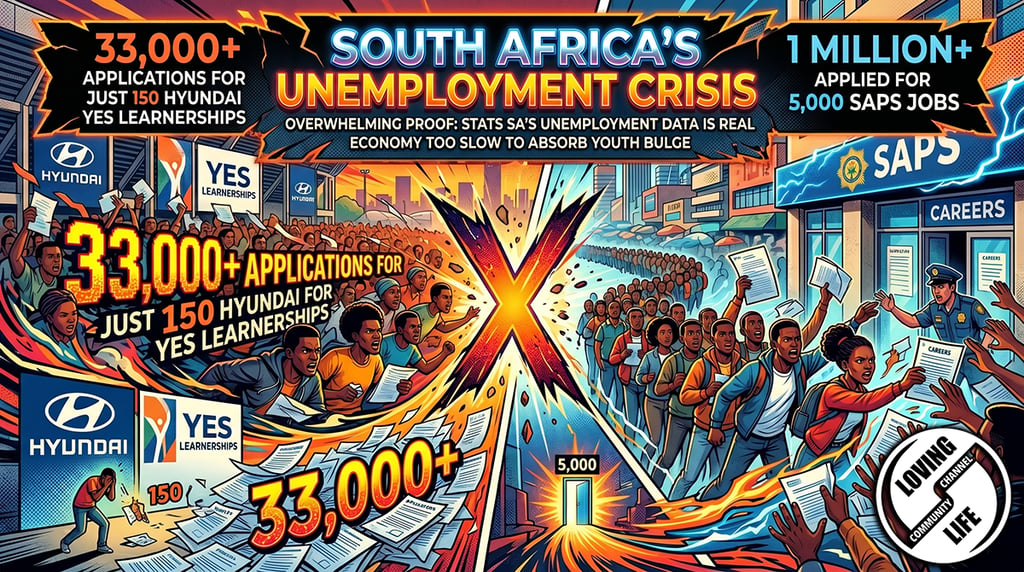
Hyundai Automotive South Africa opened applications for its 2026 Youth Employment Service learnership programme on 4 May. The response exposed the true scale of South Africa’s unemployment crisis. The company received 33,000 applications for roughly 150 available positions. More than 5,000 applications landed in the first hour after the portal opened.
Gauteng dominated with 21,058 submissions. KwaZulu Natal followed with 9,161 and the Western Cape with 2,845. The programme targets young South Africans aged 18 to 34. Successful candidates will be placed in departments such as sales, marketing, after sales, human resources and across the national dealership network. In previous years only about 30 percent of participants managed to secure full time employment after completing the learnership.
Hyundai described the flood of applications as evidence of strong brand appeal among young job seekers. That is corporate spin. The real story is desperation. When one company dangles a small number of entry level opportunities thousands of young people treat it as a lifeline. This is not enthusiasm for Hyundai. It is a snapshot of an economy that fails to produce real jobs for the majority of its youth.
The pattern is familiar. In October 2025 the South African Police Service received over one million applications for around 5,000 trainee positions. That included hundreds of thousands of university graduates. One million people competing for a few thousand government jobs tells the same story. Formal employment opportunities have become lottery tickets in South Africa.
Some business commentators argue that official Stats SA unemployment figures are overstated. They claim the data ignores extensive survivalist activity such as street trading, backyard rentals, informal car washing and small scale hawking. According to this view the real unemployment rate sits closer to 10 percent once informal work is counted. These arguments do not survive contact with reality. When 33,000 applicants chase 150 learnerships and a million chase 5,000 police posts the crisis is every bit as severe as the official statistics indicate.
Survivalist hustles exist. People do what they must to eat. But informal activity is not the same as proper employment. It rarely builds skills, provides benefits, delivers career progression or generates meaningful tax revenue. It is hand to mouth existence in an environment where the formal economy has stalled. Calling it employment simply lowers the bar and delays honest solutions.
Stanlib chief economist Kevin Lings has explained the hard numbers for years. South Africa’s economic growth currently sits between 1 and 1.5 percent. That is far too low to absorb the large number of young people entering the labour force annually. To make real progress the country needs sustained growth above 3 percent and ideally heading toward 4 percent. Anything less and the unemployment pool keeps expanding.
Since the Covid period the economy has grown by roughly 3.5 percent in real terms. Over the same period the population has grown by more than 6 percent. The result is falling per capita income. Living standards for the average South African are stagnating and in many cases declining. Infrastructure decay, energy instability, crime and policy uncertainty continue to suppress business confidence and investment.
For South Africa’s minority communities this situation creates a particularly heavy burden. White, Indian and coloured South Africans still form the core of the formal private sector. They own and manage a disproportionate share of commercial farms, small and medium businesses, professional services and skilled trades. They pay the bulk of personal and corporate taxes. Yet they watch the state fail to create opportunities for millions of unemployed citizens while their own costs rise.
Higher taxes fund ineffective programmes. Rising crime linked to joblessness forces massive private security spending. Emigration of skilled young people drains talent and further weakens the tax base. Social instability creates constant pressure on businesses and families trying to operate in this environment. The productive minority subsidises a system that cannot deliver basic economic results for the majority.
Political analyst Dr Frans Cronje offered a clear eyed assessment. Survivalist activity is real and generates some value. People hustle, trade and improvise to survive. However it is wrong to reclassify this as proper employment. In a functioning economy you do not see one million applicants for 5,000 basic government jobs. Such overwhelming demand only occurs in countries with extreme structural unemployment.
The Hyundai learnership and the SAPS recruitment stories are not isolated anomalies. They reflect a deep structural failure. The economy is not creating enough formal jobs to match population growth and labour force expansion. Decades of policy choices focused on redistribution rather than growth have produced this outcome. Energy shortages, collapsing infrastructure, high crime levels and regulatory uncertainty deter the investment needed for job creation.
Loving Life has always faced these realities without illusion. South Africa suffers from genuine mass unemployment. The data is accurate. The desperation of 33,000 applicants for 150 positions is visible and painful. Minorities who continue to build businesses, employ workers and generate wealth understand the consequences better than most. They operate daily in an environment where finding reliable skilled staff is difficult while millions remain trapped outside the formal economy.
This is not a call for despair. It is a call for realism. Self reliance has become non negotiable. Families and communities must prioritise genuine skills development, private sector experience, entrepreneurship and tradeable qualifications. Waiting for government led solutions has produced repeated disappointment. The state excels at creating learnership programmes and recruitment drives that attract massive applications but delivers limited lasting employment.
Businesses owned by minorities face extra pressure. They must navigate load shedding, fuel price spikes, crime, and now an ever growing pool of frustrated unemployed citizens. Many respond by automating where possible, tightening hiring standards, investing in private security and focusing on efficiency. These are rational survival strategies in a difficult environment.
The maths remains brutal. At current growth rates the unemployment crisis will deepen. Only significantly higher economic growth can begin to absorb new labour market entrants and reduce social tensions. That requires fixing energy supply, restoring infrastructure, cutting red tape, improving security and restoring policy certainty. None of these fixes appear imminent under the current governance trajectory.
South Africa’s minorities did not create this unemployment catastrophe. They did not design the policies that slowed growth for decades. Yet they continue to carry a disproportionate share of the burden through taxes, private costs and daily risk. The Hyundai story with 33,000 desperate applicants for 150 spots should serve as a wake up call. The scale of joblessness is real. The pressure on productive citizens will continue.
The practical response is clear. Protect your own enterprises. Develop high demand skills. Build strong community and family networks. Maintain realistic expectations about what the broader system can deliver. Focus on value creation in sectors that still function. In an economy this constrained those who adapt and remain productive will continue to carry the load.
The 33,000 applications for Hyundai positions confirm what many already know. South Africa faces a deep and persistent unemployment emergency. Recognising that fact honestly is the first step toward personal and community level solutions.