
R200 Million Cocaine Vanishes from Hawks Storage: Deliberate Inside Job or Peak ANC-Era Incompetence?
541kg (R200m) cocaine stolen from KZN Hawks Port Shepstone strong room in 2021. Madlanga Commission hears Maj-Gen Hendrik Flynn testimony: theft 'by design' with deliberate bungling, false registers, no security. Hard truths on cartel infiltration and minority costs in failing state.
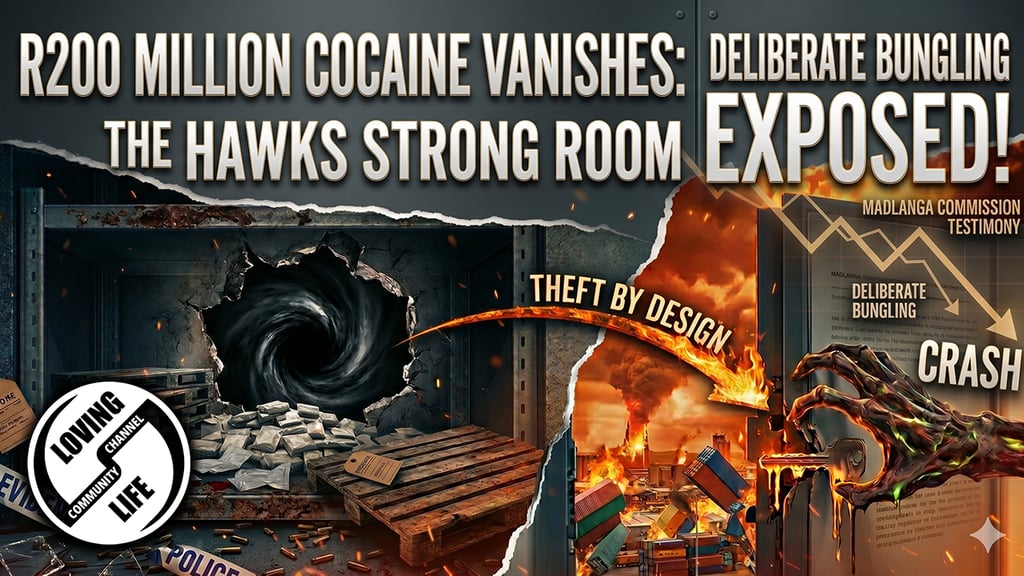
On 5 May 2026, the Madlanga Commission of Inquiry heard explosive testimony from Major-General Hendrik Flynn, Component Head for Serious Organised Crime at the Hawks (DPCI). Flynn stated unequivocally that the theft of 541 kilograms of cocaine — street value around R200 million — from the Port Shepstone Hawks offices in November 2021 was not a random burglary. It was “by design.”
The sequence began on 22 June 2021. Hawks officers, acting on intelligence received the previous day, raided a shipping container at a depot in Isipingo, south of Durban. What they expected might be 27 kilograms turned out to be 541 kilograms — 541 individual bricks packed in 27 bags, clearly marked and professionally wrapped. The consignment had arrived from Brazil. It was booked into the SAP13 exhibit register at Isipingo SAPS.
Standard protocol demanded the drugs be taken to a forensic science laboratory for analysis and then to secure SAP13 storage at a nearby police station. Instead, senior KZN Hawks leadership — under then-provincial head Major-General Lesetja Senona — ordered the entire haul moved over 100 kilometres to the DPCI offices in Port Shepstone. Flynn proved in testimony that four fully functional police stations with proven drug-storage capacity (Maidenworth, Brighton Beach, Umbilo and Durban Central) sat between 13 and 24 kilometres from the seizure scene. Yet space suddenly became an issue.
This was not the first time Isipingo SAPS had handled a comparable load. Sixteen months earlier, 547 kilograms of mandrax had been stored there without drama. Flynn highlighted the contradiction: no statement existed in any docket confirming a genuine storage crisis. Warrant Officer Mpangase made false entries in the SAP13 registers at both Isipingo and Port Shepstone. The cocaine was never sent for forensic analysis. No independent verification linked the exhibits registered at Isipingo to those later logged in Port Shepstone.
Port Shepstone was the perfect soft target. The facility had no working CCTV cameras. The alarm system was non-functional. The private security contract had not been renewed. The building had suffered multiple previous break-ins. No 24-hour armed guards were posted. Even the keys to the strong room were handled irregularly — Senona himself held them. Between 6 and 8 November 2021, thieves used a grinder to gain entry through the windows and removed every kilogram of the cocaine. Nothing else of value was taken.
Commission chairperson, retired Justice Mbuyiseli Madlanga, openly struggled to accept the narrative. He listed seven consecutive failures in a single operation and asked Flynn directly whether this could possibly be coincidence. Flynn’s measured reply: he holds “strong views” he could not yet disclose on record, but the chain of decisions was intentional.
Five years later, not one kilogram has been recovered. No arrests in the theft itself. The case remains “active” while the drugs — enough to flood entire provinces — are almost certainly back on the streets fuelling gang violence, farm attacks, hijackings and the destruction of communities.
This is not isolated incompetence. It is textbook institutional rot. Durban and KZN ports have long been preferred entry points for South American cocaine syndicates. When a major seizure actually occurs, the evidence is moved to the least secure location possible, protocols are ignored, paperwork is falsified, and the drugs disappear under the noses of the very unit supposed to dismantle the networks. Meanwhile, minority business owners, farmers and families in KZN and Gauteng continue to pay the price through heightened private security costs, insurance premiums, lost productivity and daily risk to life and limb.
The Madlanga Commission was established precisely to examine allegations of criminal infiltration within law enforcement and the justice system. Flynn’s testimony confirms what many have long suspected: some high-value drug busts are theatre. The seizure makes headlines, the cartels get their product back, and the productive taxpayers foot the bill for a collapsing state apparatus.
Loving Life has never peddled false hope. South Africa’s minorities did not create this environment of porous borders, compromised institutions and selective enforcement. But we live with the consequences every single day. While cartels treat Durban Harbour and Hawks storage rooms as low-risk logistics hubs, law-abiding citizens install electric fencing, hire armed response and teach their children situational awareness from a young age.
The hard reality is this: occasional high-profile testimony at a commission changes nothing on the ground. The cocaine is gone. The syndicates are richer and bolder. And the same governance model that enabled the original seizure to be mishandled continues to preside over the deterioration.
Self-reliance is not paranoia — it is pattern recognition. Secure your own perimeter. Build community networks that actually function. Keep accurate records. Demand facts, not press releases. Because when 541 kilograms of pure cocaine can be “lost” through seven perfectly aligned failures, the message to every minority family trying to build and protect something worthwhile is crystal clear: the system is not protecting you. It never was.
The cartels understand this. The productive must act accordingly.