
President Ramaphosa’s Reparations Call: A Legalised Excuse to Take What Isn’t Theirs
On 4 May 2026 President Cyril Ramaphosa used Africa Month to demand reparations, investment and technology transfer from former colonial powers. This is not justice. It is a legalised excuse to take what isn’t his. Africa’s real future lies in self-reliance, strong property rights and honest governance — not in grievance politics that justifies seizing what productive people have built.
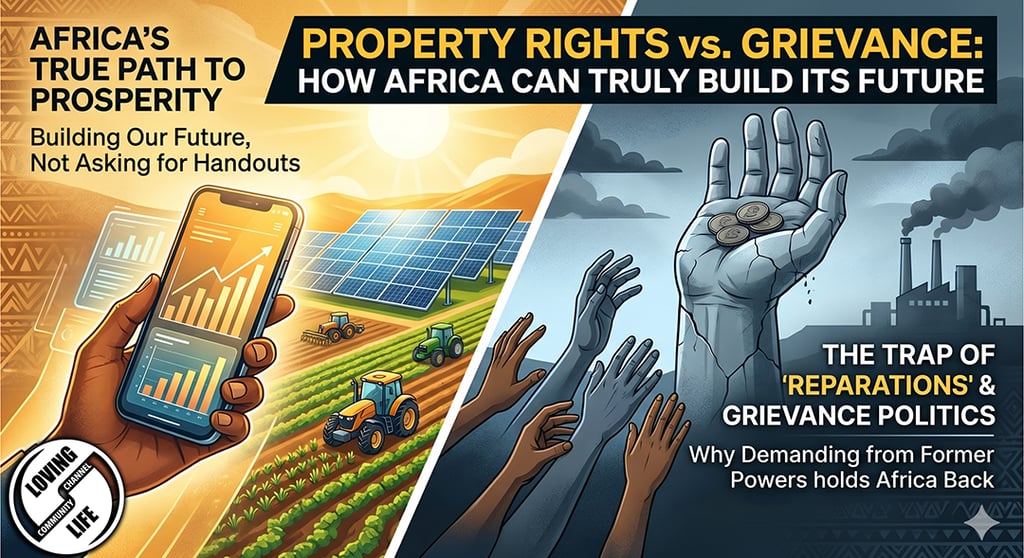
On 4 May 2026, President Cyril Ramaphosa used the launch of Africa Month to issue his weekly letter titled “Reparations must help to address Africa’s colonial legacy.” In it he demands that former colonial powers provide increased foreign direct investment, market access, skills and technology transfer, and the return of historical artefacts as forms of “redress” for slavery and colonialism. This is not a neutral historical reflection. It is a calculated political strategy that frames reparations as a legal and moral right to claim wealth created by others. In plain terms, it is a legalised excuse to take what isn’t yours.
No honest observer denies the brutality of the transatlantic slave trade or the injustices of colonial rule. Those crimes are documented facts. But turning those historical wrongs into a perpetual claim against today’s governments and taxpayers in 2026 is not justice. It is a dangerous precedent that justifies the seizure or redistribution of legitimately created wealth under the banner of historical correction. This is precisely the mindset that has repeatedly destroyed productive capacity across Africa and South Africa.
Since independence, Africa has received hundreds of billions of dollars in aid, debt relief, grants and investment from the very nations now being targeted for reparations. The results speak for themselves. Countries that protected property rights and encouraged enterprise have made real progress. Botswana, Mauritius and Rwanda stand as proof that sound policies and self-reliance work. Yet in too many cases, post-independence governments chose nationalisation, corruption, elite capture and the destruction of incentives. The result has been stagnation, poverty and repeated cycles of crisis. President Ramaphosa’s letter conveniently ignores this record of domestic failure and instead places the blame almost entirely on events that ended decades ago.
This reparations narrative is especially alarming in South Africa, where the ANC government has already pursued policies of expropriation without compensation. The same logic now being applied to former colonial powers is being used at home to target farms, businesses and assets built by productive citizens, many of them from minority communities. These are not colonial relics. These are working enterprises that create jobs, pay taxes and feed the nation. Framing them as “ill-gotten gains” that must be surrendered is not redress. It is a legalised mechanism to confiscate what others have built through risk, labour and investment.
The president’s call sidesteps the real barriers to African progress: weak institutions, unreliable electricity, crumbling infrastructure, failing education systems and rampant corruption. No amount of external payments will fix these self-inflicted problems. Wealth transferred through political pressure is rarely invested productively. It tends to disappear into patronage networks and political pockets, as South Africans have witnessed repeatedly with state capture and SOE failures.
Walter Rodney’s How Europe Underdeveloped Africa is frequently cited in these debates. Yet even that work does not explain why so many African nations have failed to develop after the colonial powers departed. The missing explanation is leadership and policy. Governments that respect property rights, enforce contracts and fight corruption create the conditions for growth. Governments that treat successful enterprises as targets for redistribution destroy the very engine of prosperity.
Ramaphosa’s letter reflects the ANC’s long-standing ideology: that wealth is something to be taken rather than created. This is the same thinking that has led to policy uncertainty, capital flight and declining investment in South Africa. While the president speaks of reparations abroad, ordinary South Africans face the daily consequences of domestic mismanagement: load-shedding, high unemployment, crumbling services and eroded property rights.
A loving embrace of life demands the opposite approach. It celebrates every individual and community that builds, produces and creates value. It protects the farmer who turns barren land into food. It defends the entrepreneur who starts a business against overwhelming odds. It honours the minority groups whose skills and capital have generated real economic activity that benefits everyone. True justice is not about punishing success today for sins of the past. It is about securing the conditions under which every person can build a better future.
Africa does not need more excuses. It needs secure property rights, independent courts, low corruption and open markets. These are the proven foundations of prosperity everywhere they have been tried. Asia’s economic miracles did not come from reparations cheques. They came from governments that stopped punishing success and started protecting it.
The United Nations General Assembly resolution of March 2026 adds diplomatic cover to these demands. But no resolution can override economic reality. Wealth is not created by international declarations. It is created by individuals who are free to work, save, invest and innovate without fear that the state or international pressure will seize the fruits of their labour.
President Ramaphosa and the ANC must be held to account for the choices they have made on their watch. Demanding reparations while presiding over policy failure at home is not leadership. It is an abdication of responsibility. Africa Month should be a celebration of African potential and achievement. Instead, this letter turns it into another platform for grievance and entitlement.
The future of Africa and South Africa will not be decided by payments extracted from Europe. It will be decided by whether leaders choose to protect what has been built, reward enterprise and empower citizens to create wealth. Anything less is a betrayal of the millions of Africans who wake up every day determined to build a better life for themselves and their families.
Self-reliance is not a slogan. It is the only proven path to dignity and prosperity. Reparations rhetoric, dressed up as moral justice, is in reality a legalised pretext to take what isn’t yours. South Africa and the continent deserve better.