
NSFAS in Crisis: R54 Billion Student Funding Scheme Placed Under Administration for the Third Time in a Decade
On 4 May 2026, the National Student Financial Aid Scheme (NSFAS) was placed under administration for the third time in less than ten years. The R54 billion scheme that supports over 1.2 million university and TVET students now faces yet another leadership takeover after a devastating disclaimed audit opinion and irregular payments of around R210 million to non-eligible students. While the minister calls it a necessary rescue mission, unions, students and Parliament are pushing back hard.
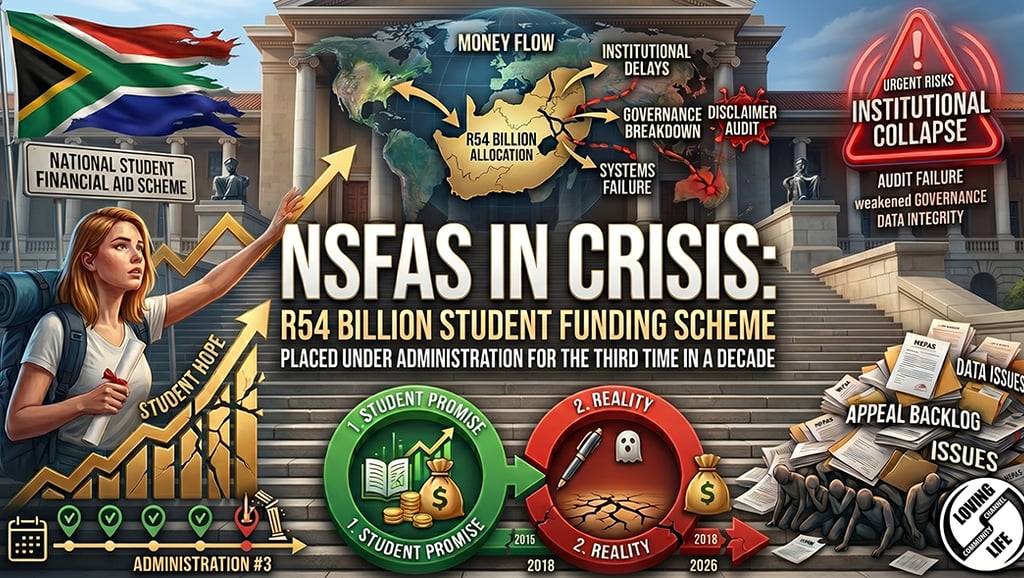
On 4 May 2026, South Africa’s higher education sector woke up to yet another headline that has become all too familiar: the National Student Financial Aid Scheme (NSFAS) has been placed under administration. Minister of Higher Education and Training Buti Manamela announced the move during a media briefing in Pretoria, dissolving the current board and appointing Professor Hlengani Mathebula as administrator for up to 24 months. For an institution that disburses more than R54 billion annually to over 1.2 million university and TVET students, this is no minor bureaucratic reshuffle. It is the third time in less than a decade that NSFAS has been taken over by an administrator, raising serious questions about whether the scheme meant to open doors for poor and working-class youth is itself beyond repair.
NSFAS exists as one of the most important instruments of social justice in post-apartheid South Africa. It funds tuition, accommodation, living allowances and books for students who would otherwise be locked out of higher education. For millions of families, a NSFAS award is not just financial support. It is the difference between a child attending university or entering the job market without qualifications. It is the bridge between generational poverty and opportunity. Yet that bridge is now crumbling under the weight of repeated governance failures, financial mismanagement and operational chaos.
The immediate trigger for the latest intervention is damning. The Auditor-General of South Africa issued a disclaimed opinion on NSFAS’s 2024/25 financial statements, the worst possible audit outcome. This means the financial records were deemed so unreliable that the Auditor-General could not even form an opinion on their accuracy. The report was submitted late, and it highlighted material irregularities and serious non-compliance. Most shockingly, NSFAS paid out approximately R210 million to students who were not eligible for funding. This included payments to 822 students recorded as deceased in the Department of Home Affairs database, over 14,000 students whose household incomes exceeded the eligibility threshold, and cases of double-dipping with other government grants. These are not small administrative slips. They represent hundreds of millions of rands diverted from deserving students to people who should never have received a cent.
Minister Manamela did not mince words when explaining the decision. He described NSFAS as “one of the most important public institutions in our democratic project,” emphasising that it exists to ensure young people from poor and working-class backgrounds can access higher education. He pointed to prolonged governance instability, board resignations (including acting chairperson Mugwena Maluleke), legal concerns around the board’s structure, and repeated failed attempts to stabilise leadership through interim appointments. Previous efforts to fix the board had not worked, he said, forcing government to act through the courts and invoke sections 17A to 17D of the NSFAS Act. “Government cannot knowingly ignore potential legal irregularities in the constitution of a statutory body entrusted with billions of rands in public funds and the future of millions of students,” Manamela stated.
Professor Hlengani Mathebula now steps into this high-pressure role. A respected academic and administrator, he currently serves as Director and Head of the Tshwane School for Business and Society at Tshwane University of Technology. With decades of experience in governance, financial management and regulatory affairs, including senior positions at the South African Reserve Bank and the South African Revenue Service, he brings a strong track record. His mandate is clear: stabilise operations, fix the ICT systems that have caused endless payment delays and backlogs, clear student appeals, improve data integrity, enforce consequence management and prepare the ground for a new, properly constituted board. Student funding and allowances will continue uninterrupted during this period, the minister has assured.
This is not NSFAS’s first rodeo with administration. The scheme was first placed under administration in 2018 under Randall Carolissen, who served until December 2021. Freeman Nomvalo followed from April 2024 to February 2025. Now, in 2026, we are on the third cycle. Portfolio Committee on Higher Education Chairperson Tebogo Letsie captured the frustration perfectly in an interview with Newzroom Afrika. “In seven years, we’ve effectively had three administrators, three board chairpersons, and two CEOs,” he said. “That shows that there is a problem, which is something we must acknowledge. We are not investigating enough what the problem may be. We need to understand why good leaders who go to NSFAS don’t last at that institution.”
The backlash has been swift and sharp from key stakeholders. The National Education, Health and Allied Workers’ Union (NEHAWU), a major union at NSFAS, expressed outrage at the lack of consultation. In a strongly worded statement, the union said it was “flabbergasted” by the minister’s decision and accused him of failing to engage stakeholders before such a major intervention. NEHAWU argued that previous administrators had themselves contributed to the “deplorable state of governance and administration” and warned that repeating the same approach would not solve underlying issues. The union called on the department to work closely with all role players, including labour, to restore stability.
The South African Union of Students (SAUS) was equally critical. It rejected the administration outright, claiming NSFAS had shown noticeable operational improvements in recent months. The union pointed out that the board had only recently appointed a new Chief Executive Officer in an effort to stabilise leadership. “This decision comes immediately after the NSFAS Board took steps to stabilise leadership,” SAUS said. “The sudden imposition of an administrator undermines the role of the Board and raises serious questions about what informed this decision and whether institutional governance processes have been respected.” Some board members are reportedly preparing to challenge the move in court with an interdict.
These criticisms highlight a deeper tension. On one side, the minister and government argue that the scale of the audit failures and financial leaks left them with no choice but to step in. On the other, unions, students and the parliamentary committee worry that repeated administrations are treating the symptoms rather than the disease. The real question is why NSFAS seems unable to retain capable leadership and build sustainable systems. Is it political interference? Chronic underfunding of critical ICT infrastructure? Weak accountability mechanisms? Or a toxic combination of all three?
The human cost of this instability is enormous. Students across the country rely on timely NSFAS disbursements for registration, accommodation and daily living expenses. Delays and backlogs have already caused registration blocks, evictions from student housing and mental health strain. In a country where youth unemployment hovers above 45 percent and higher education remains a key pathway out of poverty, any disruption to NSFAS ripples far beyond campus gates. Families who have sacrificed to get their children into university suddenly face uncertainty. The scheme’s credibility, built over years of hard-won gains, is once again under threat.
Yet there is still hope if this latest administration is handled differently. Professor Mathebula has the expertise to drive real change. His immediate priorities must include a full forensic review of the irregular payments, rapid fixes to the ICT platform that has plagued the scheme for years, strengthened data verification processes with Home Affairs and SARS, and robust consequence management for those responsible for the leaks. Long-term success will require a new board selected through a transparent, merit-based process and genuine stakeholder buy-in from unions, students and Parliament.
South Africa cannot afford to keep cycling through administrators every few years while the core problems fester. The R54 billion annual budget is taxpayers’ money, and it must reach the intended beneficiaries: talented young people from disadvantaged backgrounds who simply need a fair chance. The current crisis is not just about one institution. It reflects broader challenges in state-owned entities where good intentions meet weak execution and insufficient oversight.
As the dust settles on this latest intervention, the spotlight is now firmly on Professor Mathebula and the Department of Higher Education. Will this administration finally break the cycle of failure, or will we be reading similar headlines again in 2028? The answer matters to every student waiting for an allowance, every parent hoping their child can complete a degree, and every South African who believes higher education should be a tool for genuine transformation rather than another symbol of state dysfunction.
The NSFAS story is ultimately a test of political will. If the new administrator can deliver clean audits, efficient systems and restored trust within the next 24 months, the scheme can once again become the success story it was intended to be. If not, the cycle will continue, and another generation of students will pay the price for institutional incompetence.
For now, the message from government is that student funding continues. But words alone are not enough. South Africans, especially the students whose futures hang in the balance, will be watching closely to see whether this third administration finally delivers the stability and accountability that NSFAS so desperately needs.