
El Niño Looms: South Africa’s Bumper Harvest Today, Drought Risk Tomorrow
While South Africa is currently enjoying a strong 2025-26 summer grain and oilseed harvest of 20.8 million tonnes, the South African Weather Service’s May 2026 outlook flags a growing threat. A likely El Niño event could bring below-normal rainfall and drought conditions for the 2026-27 season, affecting rainfed crops, livestock grazing and food security. Winter crops are already showing early signs of pressure.
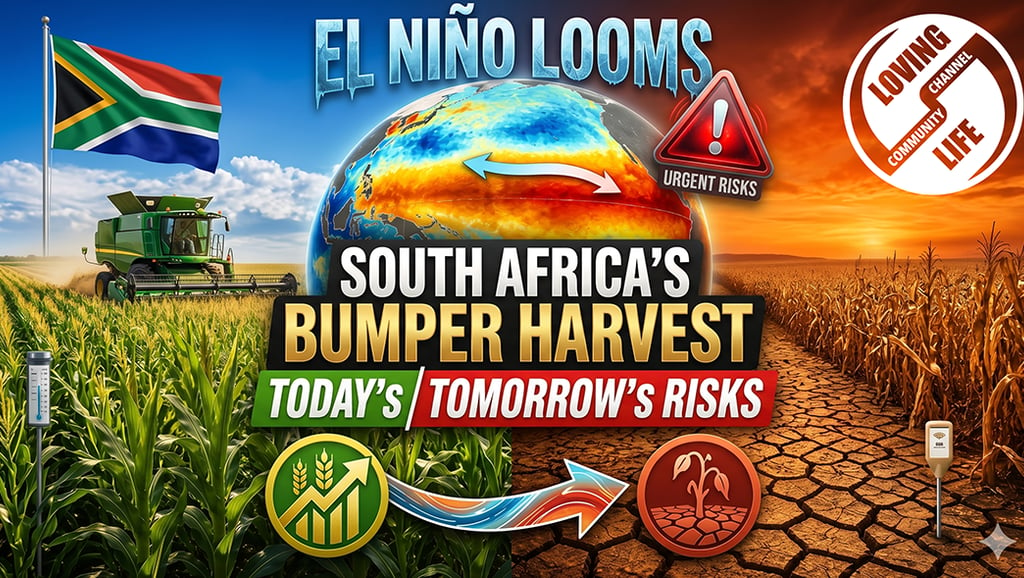
While most South Africans enjoyed good rains at the end of April 2026, the South African Weather Service (SAWS) delivered a sobering message on 1 May. The country’s excellent current harvest is masking a growing threat: a likely El Niño event that could bring drier conditions and drought risk to the 2026-27 summer season.
The SAWS Monthly Seasonal Climate Watch is clear. The El Niño-Southern Oscillation (ENSO) is currently neutral. However, predictions show it will rapidly shift toward an El Niño state within the next few months and strengthen through spring and into the start of the 2026-27 summer season in October. El Niño typically means below-normal rainfall and higher temperatures across southern Africa, especially in the summer rainfall regions that cover most of the country.
This is not immediate panic. Right now South Africa is sitting on a strong agricultural base. The Crop Estimates Committee’s latest data released last month put the 2025-26 summer grain and oilseed harvest at 20.8 million tonnes. That is a 1 percent increase year on year. Upward revisions for maize, soybeans and sunflower seed drove the gains. Dams across the country remain at healthy levels, providing a solid buffer for irrigated crops such as fruits and vegetables.
Farmers are currently focused on harvesting the final stretches of the 2025-26 summer crops. The abundance means food supplies are secure in the short term and prices should remain relatively stable through the rest of 2026. This is welcome news after several years of weather volatility.
Yet the long-range outlook is concerning. The coming El Niño is expected to affect the main summer rainfall areas starting in late 2026. Most South African arable land (roughly 80 percent) is rainfed rather than irrigated. The crops most at risk include maize, other summer grains, oilseeds, sugarcane and grazing veld for livestock. Even a moderate El Niño can reduce yields significantly in these sectors. A strong event could trigger widespread drought conditions similar to those seen in 2015-16.
Winter crops for 2026 are already showing mixed signals. April brought favourable early rainfall in many areas. However the SAWS warns that below-normal rainfall is likely later in the season, particularly in the south-western and southern coastal regions. This could hit wheat, barley, canola and oats. Farmers have already indicated they plan to reduce winter plantings this year. The decision is driven by a combination of weather uncertainty, higher input costs linked to global conflicts in the Middle East, and softer commodity prices on international markets.
The implications stretch far beyond the farm gate. Agriculture directly employs hundreds of thousands of people and supports millions more through processing, transport, retail and related industries. A poor 2026-27 season would push up food prices, strain household budgets and slow rural economies. Livestock farmers would face higher feed costs if grazing veld suffers. Sugarcane and fruit exporters could see reduced volumes for international markets.
The good news is that the current healthy dam levels will support irrigation-dependent sectors (fruits, vegetables and some high-value crops) even if rainfall is below average in the short term. This gives the country a temporary cushion. However prolonged drought would still test water management systems and force tough decisions on allocation between agriculture, industry and domestic use.
South African farmers have shown remarkable resilience in the past. Many have already adopted drought-resistant seed varieties, improved soil moisture conservation techniques and invested in precision irrigation. Yet the sector as a whole needs stronger support. This includes better early-warning systems, access to affordable crop insurance, research into climate-smart farming methods and clear government communication on expected conditions.
Policymakers and agribusiness leaders must start preparing now. The Crop Estimates Committee and SAWS will release updated forecasts throughout the year. These will guide planting decisions for the 2026-27 summer season. The current bumper harvest buys valuable time, but that time must be used wisely. Lessons from previous El Niño events should be applied quickly: stockpile strategic reserves where possible, accelerate water infrastructure projects and support farmers with the right financial tools.
This weather outlook arrives at a sensitive moment. South Africa is still recovering from the economic effects of earlier droughts and the COVID-19 pandemic. Food security remains a national priority. Rural communities, many already facing high unemployment, cannot afford another major crop failure.
The SAWS report is not a prediction of certain disaster. It is a probability forecast that gives farmers, government and the private sector months to prepare. The difference between a manageable dry season and a full-blown agricultural crisis often comes down to proactive planning.
As May 2026 unfolds, the focus for now remains on completing the strong 2025-26 harvest and monitoring winter crop development. But behind the scenes, attention is already shifting to October and beyond. The coming El Niño will test the resilience of South Africa’s farming sector once again.
Farmers, extension officers, commodity organisations and policymakers all have a role to play. Clear communication, timely support programmes and investment in climate adaptation will determine how well the country weathers the next dry period.
For ordinary South Africans the message is simple. Enjoy the current abundance while it lasts. Support local agriculture. And understand that the weather patterns we are seeing today are a reminder of how closely our food security is tied to long-term climate trends.
The 2025-26 season has delivered a gift. The real test will be how South Africa uses that gift to prepare for the drier conditions that may lie ahead in 2026-27.