
Porous Borders, Stolen Fences: SANDF Troops on Operation Corona Fight an Uphill Battle
In the vast open stretches of South Africa’s 5,860 kilometre land border, SANDF soldiers on Operation Corona are doing one of the toughest jobs in the country with one hand tied behind their backs. The biggest problem is simple: there is often no fence at all. When new fencing goes up, communities steal it for their own use. The result is a frontier full of gaps that invites illegal crossings, smuggling and livestock theft. This is the daily reality facing troops in May 2026.
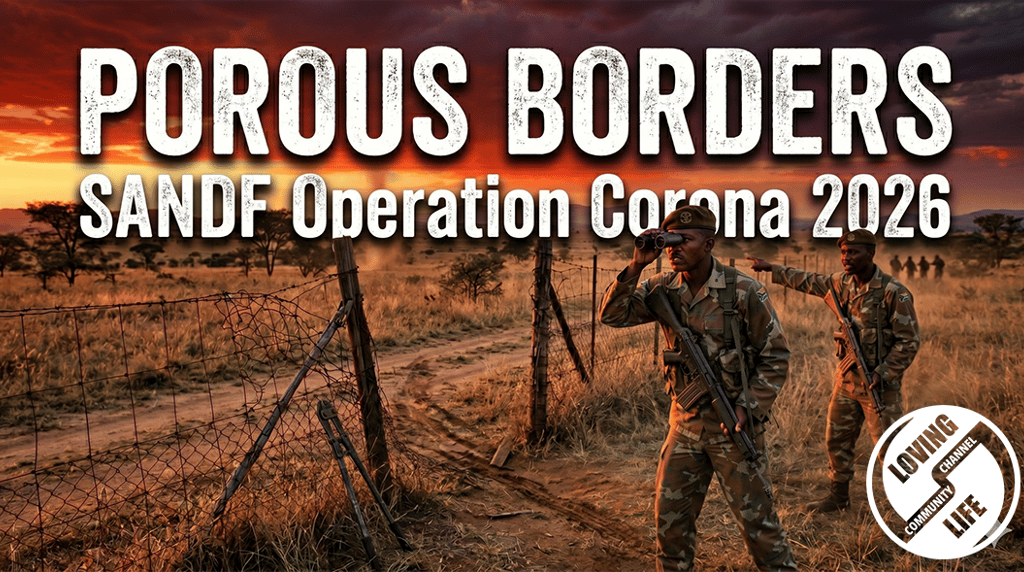
In the vast, open stretches of South Africa’s 5,860-kilometre land border, soldiers of the South African National Defence Force (SANDF) are doing one of the toughest jobs in the country with one hand tied behind their backs. On 5 May 2026, SANDF Communication Officer Lieutenant Colonel Mpho Mathebula laid it bare: where there is no physical barrier, the very concept of a border becomes difficult to enforce.
The biggest headache is missing fencing. Especially along the 2,000-plus kilometre South Africa-Botswana border in the North West province. An intelligence officer deployed there put it bluntly: There is no fence. When government installs new fencing, local communities simply steal it to secure their own kraals and immovable property. The result is a porous frontier that invites illegal crossings, smuggling, livestock theft and even informal tax collectors who prey on vulnerable migrants.
This is not a minor inconvenience. It turns what should be a clear line of sovereignty into a series of gaps and portals. Undocumented persons, narcotics, stolen vehicles, contraband and firearms flow through with relative ease. Mathebula’s report, drawn from troops on Operation Corona (the SANDF’s standing border-protection mission), highlights how the absence of secure infrastructure undermines every patrol, every checkpoint and every interception effort.
Operation Corona deploys roughly 2,810 SA Army personnel (regular force and reserves) along South Africa’s land borders with Botswana, Lesotho, Mozambique, Eswatini and Zimbabwe. According to a recent parliamentary reply to MK Party Chief Whip Mzwanele Manyi, 61 percent of the total border length is under continuous coverage. But continuous coverage means soldiers on foot, in vehicles and at vehicle checkpoints, not an impenetrable wall. Without fencing, the job becomes exponentially harder.
The problem is not new, yet it persists. Responsibility for border fencing lies with the Department of Public Works and Infrastructure (DPWI). The last major visible push came in 2020 when then-Minister Patricia de Lille ordered 40 km of fencing on either side of the Beitbridge port of entry as a COVID-19 control measure. Four years later, large sections of the Botswana and Lesotho borders remain wide open.
Similar frustrations exist elsewhere. In the Free State, the Caledon River forms part of the Lesotho border. When water levels drop in winter, crossings become even easier. Former DA provincial parliamentarian Roy Jankielsohn highlighted the issue years ago after a site visit near Fouriesburg, noting the lack of visible policing and the impact on farmers: livestock theft, seed theft and declining farm values.
On the Mozambique-KwaZulu-Natal border, a decade-old tender for an 8 km jersey barrier wall turned into a corruption scandal. The joint venture of ISF Construction Services and Shula Constructions was paid R84.3 million but only completed 5 km, leaving associated works unfinished. In recent months the Special Investigating Unit (SIU) set aside the R85.7 million contract, ordered the companies to repay profits, and directed disciplinary action against officials. The KZN Department of Transport had to issue a new tender costing an extra R62 million just to finish the job. Taxpayers paid twice.
Despite these systemic failures, the men and women of Operation Corona continue to deliver results. The 2025 statistics, released in a parliamentary reply, paint a picture of quiet professionalism under difficult conditions:
Firearms valued at R118,500 intercepted and handed over Narcotics (mostly dagga, but also methamphetamine) worth nearly R32 million 8,399 illegal immigrants apprehended 207 wanted criminals arrested 9,204 kg of unspecified contraband 115 kg of precious metals (including gold) valued at R488,500 109 stolen vehicles and five trailers recovered Livestock worth R13 million impounded
These figures represent thousands of hours of foot patrols, vehicle checkpoints and rapid-response operations. Recent incidents in April 2026 show the work never stops.
On 14 April, soldiers from 20 SA Infantry Battalion in the Eastern Cape rounded up 310 cattle that had wandered, or been deliberately placed, onto the protected Ongeluksnek Nature Reserve near the Lesotho border. The animals, valued at R31 million, were herded into a kraal while investigations continue. It was not the first such recovery.
Earlier that month, troops from 14 SA Infantry Battalion on the Mpumalanga-Mozambique border spotted smugglers in the Macadamia area of responsibility. The suspects fled, abandoning 12 bales of contraband later valued by SARS at R72,000.
In the Ficksburg area (Free State-Lesotho border), members of 10 SA Infantry Battalion’s Bravo Company, Platoon 3, encountered suspects carrying six boxes of branded clothing during a routine patrol. The suspects dropped the goods, worth an estimated R1,984,500, and fled across the river into Lesotho.
These successes come at a cost. Soldiers operate in remote, harsh terrain with limited infrastructure. The frustration is palpable: every gap in the fence means more work, more risk and more opportunities for criminals to evade justice. Cross-border crime also fuels rural insecurity. Farmers lose stock and equipment. Communities suffer from the flow of drugs and firearms. The economy loses revenue when smugglers undercut legitimate trade.
The bigger picture is one of chronic under-investment in basic border infrastructure. Physical fencing is not a silver bullet. It must be paired with technology, intelligence, community engagement and visible policing. But without the fence, the soldiers are essentially asked to hold the line with presence alone. As Mathebula noted, the lack of barriers creates a porous environment that invites illegal crossings and simplifies the movement of illicit goods and stolen livestock.
Fixing this requires urgent, coordinated action. The DPWI must prioritise a multi-year border-fencing programme with proper maintenance budgets. Communities along the border need to be partners, not adversaries, perhaps through local employment schemes tied to fence protection and maintenance. Procurement processes must be cleaned up so that scandals like the KZN jersey barrier do not repeat. And Parliament should demand regular updates on progress, holding the relevant departments accountable.
South Africa’s borders are not just lines on a map. They protect jobs, food security, public safety and national sovereignty. The soldiers of Operation Corona are doing their part, often under-appreciated and under-resourced. The least the rest of the state can do is give them the most basic tool of the trade: a proper fence.
Until then, the daily reality on the ground remains the same: dedicated troops patrolling endless open veld, chasing shadows through gaps that should never have existed.