R2 Billion Vanishes: The Daybreak Foods Scandal and the Cost of Corruption
In April 2026 a parliamentary oversight visit exposed one of South Africa’s most shocking public investment failures. Over R2 billion of workers’ and public money has disappeared at Daybreak Foods. A former top poultry producer is now in business rescue after years of alleged fraud, poor governance and corruption, leaving thousands of jobs destroyed and rural communities devastated.
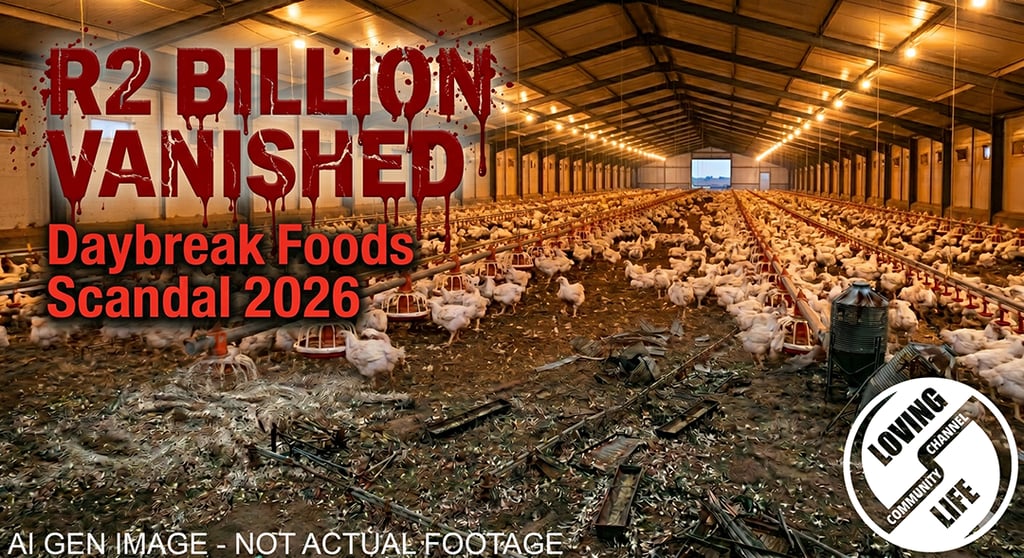
In April 2026, a parliamentary oversight visit to a poultry farm in Bela-Bela, Limpopo, exposed one of the most damning cases of public investment failure in recent South African history. Daybreak Foods, once a flagship operation in the national poultry industry, now stands as a symbol of how mismanagement, fraud and corruption can destroy billions in workers’ money and thousands of jobs.
The numbers tell a devastating story. Before the Public Investment Corporation (PIC) stepped in, Daybreak Foods was part of the Afgri group and operated across Gauteng, Mpumalanga, Limpopo and KwaZulu-Natal. It controlled the entire poultry value chain from breeding to processing. At its peak the company produced around 9 million birds per 34-day cycle, generated annual revenue of R3.8 billion and employed more than 3,400 South Africans. It ranked among the country’s top poultry producers and delivered fresh and frozen chicken products to markets nationwide.
In 2015 the PIC acquired the business for R1.19 billion. The investment was framed as support for socio-economic development and transformation. Over the next decade the PIC injected more than R2 billion in total funding. The Unemployment Insurance Fund (UIF) and Compensation Fund each added R400 million in 2016, later converted to equity, and both recently extended another R150 million each. These were supposed to be investments that protected jobs and grew the economy. Instead they became a black hole.
By 2025 the company had collapsed. Operations deteriorated so badly that farms could not even feed the chickens. In April 2025 the National Council of the Society for the Prevention of Cruelty to Animals (NSPCA) had to cull more than 350,000 birds that had been left without feed for days, leading to starvation and cannibalism. In June 2025 Daybreak Foods entered voluntary business rescue. Business rescue practitioners immediately scaled down operations and retrenched more than 2,000 workers. Today the company is a shadow of its former self. Revenue has collapsed to almost nothing and only around 300 people remain employed.
On 28 April 2026 the Standing Committee on Finance conducted an oversight visit to the Bela-Bela site. The findings were brutal. Committee Chairperson Joe Maswanganyi described the collapse as horrible and disappointing. He stated there must be consequences. It cannot be that such an important company collapses and no one is held accountable while workers’ money simply disappears. ActionSA MP Alan Beesley was equally direct. When the PIC invested 10 years ago, he said, the company had R3.8 billion in revenue and employed over 3,000 people. Today it is a shell. The PIC invested over R2 billion and the money is gone.
The problems that destroyed Daybreak Foods are now well documented: poor financial controls, irregular expenditure, fraud and outright corruption. After the acquisition the company suffered repeated governance failures. The business rescue team has suspended the Chief Financial Officer and is actively seeking strategic equity partners to inject fresh capital and revive operations. The PIC, which now owns the company outright, is trying to sell a majority stake of more than 60 percent.
This is not just a corporate failure. It is a direct blow to ordinary South African workers. The UIF and Compensation Fund exist to protect the contributions of employees across the country. Instead those funds have been poured into a failing entity with no return. The Democratic Alliance has written to the Portfolio Committee on Employment and Labour demanding that the UIF, Compensation Fund and PIC appear before Parliament to account for the continued use of public money in a collapsing business. The DA asks a simple question: why are entities entrusted with safeguarding workers’ contributions still injecting funds into a company that has already received more than R1.4 billion in support over time?
The human cost is clear. More than 2,000 families lost their livelihoods when retrenchments hit. Rural communities in Limpopo that once depended on the plant for income and economic activity now face higher unemployment. The collapse also damages public trust in the PIC, an institution that manages trillions in pension and government funds on behalf of millions of South Africans. When developmental investments are allowed to collapse through alleged corruption, the entire model of using public money for transformation comes under scrutiny.
Parliamentary voices from across parties are united in demanding action. The Standing Committee on Finance has called for those responsible to face real consequences. Forensic investigations, criminal referrals and full accountability are now essential. Without them the pattern of large state-linked projects failing will continue and ordinary citizens will keep paying the price through lost jobs, wasted taxes and eroded services.
Daybreak Foods was never just another poultry company. It was meant to be a success story of transformation in agriculture, a sector critical for food security and rural development. Its fall shows how quickly good intentions can be undone when oversight fails and corruption takes root. The company is currently under business rescue with the PIC still financing the process in hopes of revival. But even if a rescue succeeds, the damage done over the past decade cannot be undone.
This scandal arrives at a time when South Africa can ill afford more value destruction. The country needs strong agricultural anchors to create jobs, feed the population and drive growth. Instead a once-thriving operation has been reduced to a fraction of its size while billions in public and worker funds have evaporated.
The oversight visit in late April 2026 has at least put the issue firmly on the national agenda. Now it is up to Parliament, law enforcement and the PIC board to ensure that the next chapter is one of accountability rather than further cover-ups. Workers whose money funded this disaster deserve nothing less.
The Daybreak Foods story is a stark reminder that public investment without rigorous governance is not development. It is simply expensive failure. South Africans will be watching closely to see whether anyone is finally held responsible.