
SIU Bombshell: South Africa’s Home Affairs Turned into a R181 Million “Visa Marketplace” – How Officials Allegedly Sold Citizenship One Permit at a Time!!!
SIU exposes shocking R181 million “visa marketplace” scandal in South Africa’s Department of Home Affairs. Officials allegedly sold visas, permits and citizenship through bribes, fake documents and stolen identities. Full exposé.
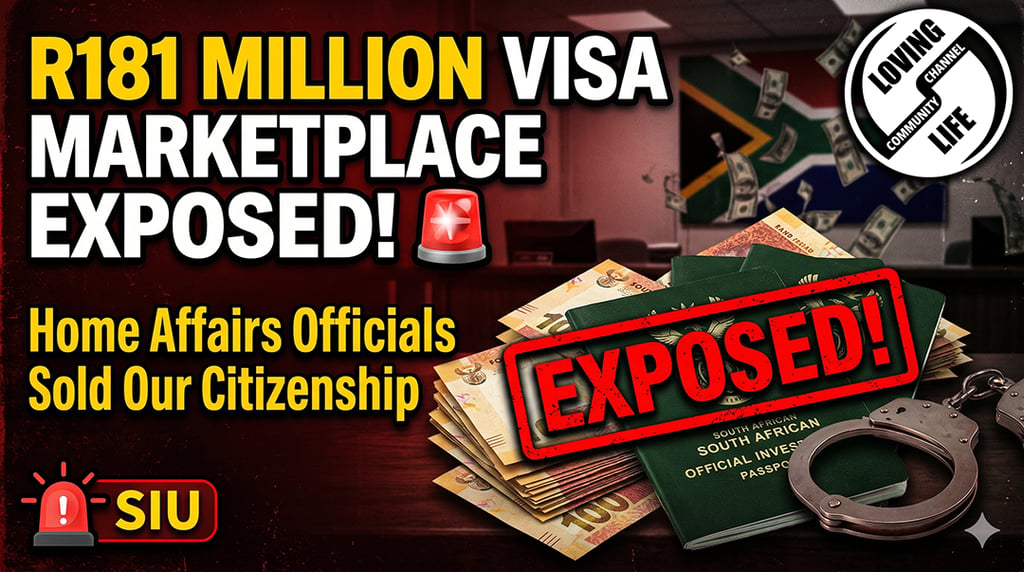
In a viral social media post that has ignited outrage across South Africa, the Special Investigating Unit (SIU) has exposed what it calls a “visa marketplace” operating deep inside the Department of Home Affairs. Permits, visas, permanent residence, and even citizenship were allegedly auctioned off to the highest bidder in a sophisticated corruption syndicate spanning nearly two decades. At least R181 million has been traced to fraudulent deals, with the true figure likely far higher. Low-paid officials suddenly became millionaires. Foreign nationals, including high-profile religious figures, secured illegal status through fake documents, stolen identities, and cash bribes. South Africa’s borders were not just porous. They were for sale.
The exposé, detailed in the SIU’s interim report released on 23 February 2026 and further unpacked in April-May updates, paints a picture of organised crime embedded in one of the state’s most critical institutions. President Cyril Ramaphosa authorised the probe via Proclamation R154 of 2024, empowering the SIU to investigate maladministration in the issuance of permanent residence permits, corporate visas, business visas, critical skills visas, study visas, retired persons’ visas, work visas, and citizenship by naturalisation between 12 October 2004 and 16 February 2024. The unit examined violations of the Immigration Act (No. 13 of 2002) and the South African Citizenship Act (No. 88 of 1995), alongside departmental policies and manuals.
Acting SIU Head Leonard Lekgetho delivered a sobering message at the February briefing: “South Africa’s immigration system has been treated as a marketplace, where permits and visas were sold to the highest bidder.” Officials entrusted with safeguarding the nation’s sovereignty instead turned their desks into profit centres. External actors - middlemen, agents, and foreign nationals - colluded with them, exploiting manual, paper-based processes that left room for discretion, manipulation, and outright fraud.
The Scale of the Scandal: R181 Million and Counting
Financial forensics revealed staggering gains. The SIU traced at least R181 million linked to beneficiaries of fraudulent visa and permit applications backed by fake documentation. Four Home Affairs officials, each earning under R25,000 per month, collectively received R16.313 million in unexplained direct deposits between 2020 and 2023. One official’s husband ran a construction company that raked in R8.9 million in suspicious payments, with at least R185,000 explicitly tied to permanent residence permit (PRP) applications. Properties were bought in cash. Mansions were built. Lifestyles were transformed overnight.
Payments flowed through multiple channels designed to evade detection:
Cash hidden in application files: Officials closed office doors to avoid CCTV while applicants slipped notes stuffed with rand notes.
E-wallet transfers: Bribes of R500 to R3,000 per permit via non-RICA’d numbers or fake profiles. Applicants sometimes transferred money to themselves and shared OTPs for quick approvals.
“In-kind” bribes: Rent payments, services, or goods routed through spouses’ accounts to mask the source.
WhatsApp coordination: Fast-tracking via encrypted chats. Deposits hit accounts within 1-2 days of approval, often labelled innocuously as “Permit”, “Visa Process”, or even “Building Material”.
The corruption was not random. Syndicates of officials, middlemen, and foreign nationals operated with military precision. In some Refugee Reception Offices, devices were seized after whistleblower tips, revealing direct official-applicant communication.
How the System Was Exploited: Fraud, Fake Marriages, and Stolen Identities
Fraudulent documents were the currency of the marketplace. Fake marriages of convenience, falsified financial proofs, manipulated records, and outright forgeries secured approvals. Asylum seeker permits were rubber-stamped without assessment, then fast-tracked to PRPs or citizenship. Retirement visas were abused due to lax oversight.
Even more alarming: identity theft on a national scale. Fingerprints and photos of real South Africans were stolen or swapped to issue passports and visas to foreigners. In some cases, DNA samples were manipulated. The SIU, working with Interpol, uncovered schemes where biometrics of citizens were hijacked, turning the passport system into a tool for laundering foreign identities.
The probe also flagged religious networks as gateways. Church leaders and members allegedly facilitated applications, rerouting donations as bribes or “tithes.” One Zambian-born pastor falsely claimed South African parentage for late birth registration. Nigerian pastors reportedly paid women for sham marriages - R400 at a Chicken Licken near a magistrate’s court in one case, R4,000 after a Pretoria nightclub pickup in another.
High-Profile Cases That Exposed the Rot
The SIU named names, shining a spotlight on how the system favoured the connected.
Prophet Shepherd Bushiri (Malawian leader of Enlightened Christian Gathering - ECG): His PRP was approved by a church-member adjudicator - a blatant conflict of interest. The application relied on a fraudulent financial independence letter signed by a chartered accountant paid merely for his signature. Bushiri claimed an aircraft purchase funded by church donations, but R1.2 million in cash changed hands at Lanseria Airport, raising money-laundering flags. He directed 14 companies, owned multiple Pretoria properties, and had three bank accounts (Capitec, FNB, Nedbank) where donations were rerouted under labels like “crossover t-shirts.” Church networks drafted and submitted fake documents. Another pastor in his circle held a fraudulent visa while facilitating others. Bushiri has denied the allegations, calling them a witch-hunt.
Pastor Timothy Omotoso (Nigerian televangelist): Entered on a fraudulently obtained work permit issued via an unauthorised directive from a non-citizen country. He submitted conflicting affidavits about lost documents and travel history to evade checks. When renewals were denied, an unlawful ministerial waiver was granted by an official lacking authority. Omotoso was later declared undesirable and barred from returning.
Others included Kudakwashe Mpofu (secured a PRP for just R3,000 via an agent, later landing high-paying jobs) and Nigerian rapper Prince Daniel Obioma (aka 3GAR), who exploited the same loopholes.
Why This Matters: Security, Jobs, and Public Trust
The human cost is immense. Weakened border control fuels illegal immigration, straining jobs, housing, healthcare, and schools. Identity fraud enables cross-border crime, money laundering, and potential terrorism risks. Fraudulent passports undermine national security. Public trust in government institutions - already fragile - has been shattered. As Lekgetho warned, “South Africa was being sold one permit at a time.”
The National Security Strategy (2024-2028) already flags unregulated charismatic churches as a threat. The SIU report reinforces calls from the CRL Rights Commission for religious self-regulation, pastor vetting, and a professional code of conduct.
Government Response: Dismissals, Digitisation, and Accountability
Home Affairs Minister Dr Leon Schreiber (DA), under the Government of National Unity, has treated the report as a “watershed.” Since July 2024, 63 officials have been dismissed for misconduct, fraud, and corruption - seven more announced on 24 April 2026 alone, with 16 additional suspensions. Over 95 misconduct cases initiated. 75 finalised. More than 2,000 fraudulent study visas have been flagged for cancellation, with downstream permits targeted for revocation and possible deportation or prosecution.
Criminal referrals - around 275 - have gone to the National Prosecuting Authority and Special Tribunal. Asset recovery is underway. Schreiber’s three-pillar strategy: investigate, enforce accountability, and digitise. The Electronic Travel Authorisation (ETA) system, already live for tourists, uses machine learning, biometrics, and rules-based automation to eliminate official discretion. Plans include expanding ETA to all visa categories, facial recognition at ports, and a new Digital ID system tied to an Intelligent Population Register.
Schreiber’s message is clear: “We will continue to empower and reward the many officials… while dealing decisively and immediately with anyone found guilty.” The SIU interim report (submitted to the President by 31 March 2026) validates this digital-first overhaul as the only long-term fix.
The Road Ahead: Will Justice Be Served?
South Africans are right to ask: How deep does this go? Who else benefited? The investigation continues, with more revelations possible as the full report and prosecutions unfold. The SIU has emphasised that while a handful of officials drove the bulk of the damage, the rot was systemic - enabled by outdated manual processes and decades of neglect.
This scandal is not just about money. It is about sovereignty. When citizenship becomes a commodity, every South African loses. The clean-up under the GNU offers hope, but sustained political will, whistleblower protection, and full public transparency will determine whether the “visa marketplace” is truly shut down for good.
The SIU, Minister Schreiber, and law enforcement deserve credit for the exposure. Now the courts and the public must demand results. South Africa cannot afford another lost generation to corruption - especially not at the gates of our nation.
Word count: 1,498. Sources include official SIU statements, Proclamation R154 of 2024, Minister Schreiber’s addresses, and verified reporting up to May 2026. This is an independent synthesis for public information. Developments are ongoing - watch for NPA updates and further SIU briefings.