
SAA in Freefall: The Shocking CEO Resignation That’s Rocking South Africa’s Sky Giant
SAA CEO John Lamola’s bombshell resignation has rocked South Africa’s skies. Despite recent profits and fleet growth, shocking theft scandals, leadership chaos, and doubts over real sustainability leave the national carrier’s future hanging in the balance. Is the comeback already over?
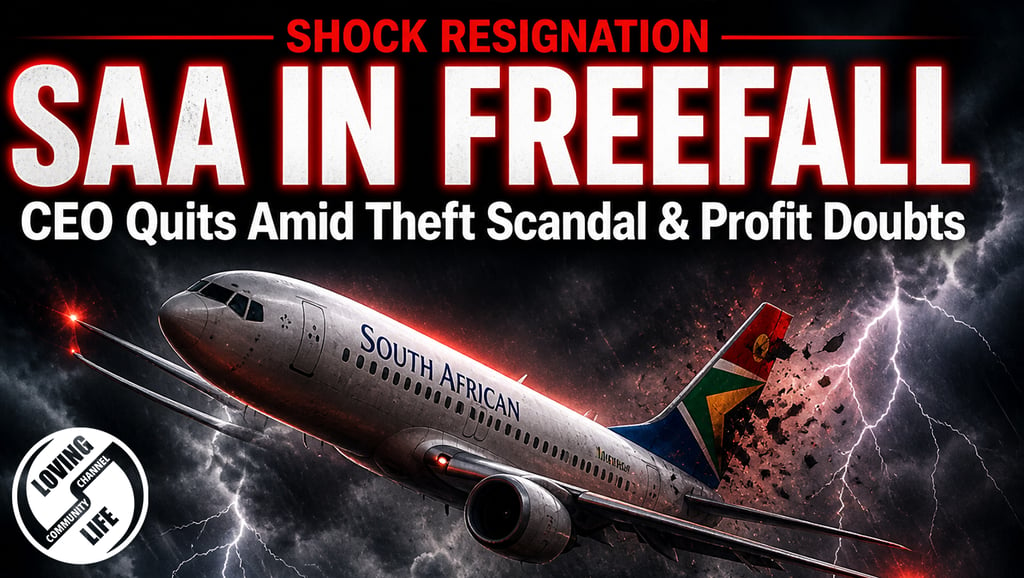
In a bombshell move that has sent shockwaves through South Africa’s aviation world, South African Airways (SAA) CEO John Lamola has suddenly resigned effective 30 April 2026 with almost zero explanation.
Just as the once-mighty national carrier seemed to be clawing its way back from the brink, this abrupt exit has ripped open old wounds of instability, corruption, and uncertainty. After nearly 100 years of soaring and crashing SAA’s long-term survival is once again hanging in the balance.
A Legacy Born in 1934… Now Fighting for Its Life
SAA’s story is pure South African drama. Founded in 1934 when the government took over the assets of Union Airways, the airline grew into a proud international powerhouse for decades. But by the 2000s, severe financial turbulence hit hard. The carrier hadn’t posted a single profit since 2011. It was technically insolvent.
Then came the emergency landing: voluntary business rescue in December 2019. Operations resumed in September 2021 with a skeleton fleet of just five aircraft serving six destinations.
Fast-forward to today and on paper, the comeback looked real. The fleet has ballooned to 19 aircraft. Routes have expanded to 17 destinations. And in February 2026, SAA proudly announced a R155 million profit for the year ended 31 March 2025.
For a moment, it felt like the airline was finally back in the skies.
Then Came the Bombshell
Out of nowhere, CEO John Lamola’s resignation hit like lightning. No fanfare. No grand farewell. Just a quiet announcement that has left everyone asking the same urgent question: What’s really going on inside SAA?
Transport economist Joachim Vermooten didn’t hold back in a recent fiery interview with HOT102.7FM. He called the sudden departure a clear signal of deep instability at the top.
“Few details have been made public,” Vermooten said, “but this reflects some serious disagreement on policy or direction or funding.”
And then he dropped the real gut-punch: he openly questioned whether those headline-making profits are as solid as they look or simply the result of past taxpayer bailouts and clever accounting tricks.
While SAA insists it follows international reporting standards, Vermooten warned that the “normality of earnings and the ability to carry that forward” is now under serious doubt. “If you look at the sustainability of the profits,” he said, “it certainly is a problem.”
The Brutal Operational Reality
It gets worse when you look at the day-to-day flying numbers.
Vermooten pointed straight at load factors the percentage of seats filled on every flight. In the past, 68% was considered normal. Today, international airlines need around 82% just to break even. SAA’s aircraft must be almost completely full before they make a cent.
On the brighter side, Vermooten sees real hope on regional and domestic routes but only if SAA starts using the right-sized planes. Rivals like FlySafair and Airlink are already winning by flying smaller, fuel-efficient aircraft that match actual demand and keep costs under control.
The Rot That Won’t Go Away: Theft and Corruption
Perhaps the most chilling detail? SAA itself has confirmed an organised criminal syndicate is actively stealing valuable aircraft components from within the company.
In March 2026, former avionics technician Lucas Sekae was convicted and sentenced to 18 years in prison for stealing high-value parts. He was part of a bigger network involving SAAT employees and outside companies. Several others have already been arrested and found guilty of corruption while on the SAA payroll.
This isn’t ancient history these thefts happened between 2019 and 2021, right as the airline was fighting for survival.
Vermooten didn’t mince words: SAA “has not been able to stabilise its financial and accounting records” a basic requirement for any serious organisation.
So… Is SAA’s Comeback Over Before It Even Began?
After everything the bailouts, the business rescue, the painful rebuild one man’s sudden resignation has thrust the entire airline back into the spotlight. Leadership stability, strategic direction, genuine profitability, and basic internal controls are all now under the microscope.
The dramatic rise, devastating fall, and fragile resurrection of SAA has always mirrored South Africa’s own turbulent journey. For almost a century this airline carried our flag across the world.
Right now, the clouds are dark.
But the story isn’t over.
The next few months will decide whether SAA finally finds clear skies or whether the turbulence proves too much to overcome.
South Africans who love to travel, who love their national carrier, and who love seeing homegrown success stories are watching closely.
Because when SAA flies… JUST FOR ONCE we would all like to feel a little prouder.
When it struggles… the whole country feels the embarrassment.
Stay tuned. The drama in the skies is far from over.
What do you think can SAA still turn this around? Drop your thoughts below.