
Sassa and Postbank Locked in Bitter R116 Million Feud Over Social Grant Fees
Sassa and Postbank are clashing over R116 million in unpaid grant fees after Sassa cancelled their long-standing payment agreement. Grants are safe and payments continue as normal, here’s what beneficiaries need to know.
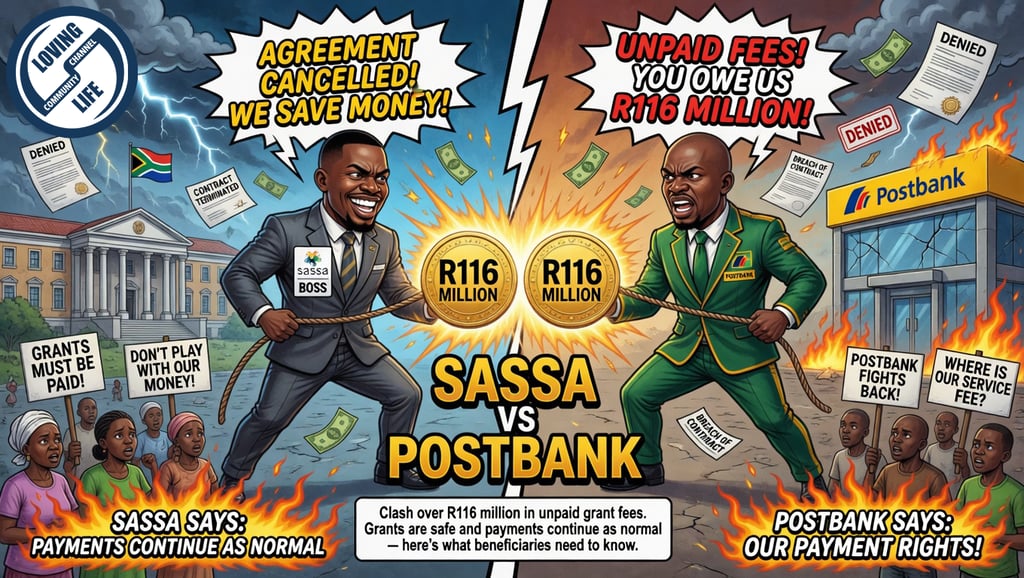

Sassa and Postbank Locked in Bitter R116 Million Feud Over Social Grant Fees Heated dispute escalates as Postbank threatens legal action against Sassa for unpaid service fees - but your grants are safe for now
3 May 2026 - A fiery public showdown has erupted between the South African Social Security Agency (Sassa) and Postbank over the cancellation of their long-standing Master Service Agreement (MSA) for paying out billions in social grants each month.
Postbank has fired the latest shot: a strongly worded lawyers’ letter dated 21 April 2026 demanding immediate payment of just under R120 million (R116 million plus VAT) in “service fees” that Sassa has refused to pay since October 2025. The bank accuses Sassa of dragging its feet for more than six months despite repeated attempts to resolve the standoff.
How Did We Get Here?
The roots of the clash go back to 2018, when Sassa signed the MSA with the South African Post Office (Sapo) to handle grant disbursements after the Cash Paymaster Services scandal. When Sapo went into business rescue in 2023, the contract was ceded to its banking arm, Postbank.
Under the deal, Postbank acted as Sassa’s primary disburser. Crucially, no bank fees were ever deducted from beneficiaries’ grants. Instead, Sassa paid Postbank a fixed monthly service fee (around R20 million) to cover over-the-counter cash payments at Post Offices and special Cash Pay Points. The arrangement was designed to protect South Africa’s most vulnerable citizens - pensioners, disability grant recipients and child-support families - from commercial banking charges that could eat into their grants.
But things changed dramatically in 2024. The Auditor-General flagged the MSA as irregular because it was never put out to public tender. Over-the-counter services at Post Offices largely ended after Sapo’s financial meltdown, and the vast majority of the 3 million Postbank grant recipients (98.5 %) now access their money fee-free through ordinary ATMs and retailer point-of-sale machines via the national payment system.
Sassa gave formal notice to terminate the agreement back in December 2023. After legal wrangling over the notice period, the contract officially ended on 30 September 2025.
The Debt Bomb Explodes
Postbank continued invoicing Sassa every month for the “special services” it claims it was still providing. Sassa stopped paying from October 2025 onward, arguing the MSA was dead and the subsidy was no longer justified.
By March 2026 the unpaid invoices had piled up to R116 million (inclusive of VAT). In last week’s letter, Postbank CEO Nikki Mbengashe warned that the bank had “extended Sassa every reasonable opportunity to resolve this matter” and made it clear that court action is now on the table.
Sassa’s position is blunt: the special fee arrangement was never meant to be permanent once the unique services disappeared, and taxpayers should not keep subsidising a service that most beneficiaries no longer use.
What Does This Mean for the Millions Who Rely on Grants?
The good news - repeated loudly by both sides and by the Department of Social Development - is that social grant payments themselves are completely unaffected.
Grants are still paid directly into beneficiaries’ bank accounts (including Postbank accounts) on the normal schedule.
You can still use your Postbank Black Card (or legacy Sassa Gold Card until the final migration deadline of 31 December 2026).
The vast majority of people already withdraw or spend their grants without any bank fees through ATMs and shops.
Postbank, however, warns that without the MSA subsidy, some vulnerable users could eventually face standard banking charges for things like balance enquiries, card replacements or mini-statements. Sassa counters that beneficiaries are free to bank with any institution they choose and that competition will keep costs down.
Legal and Political Fallout
This is not the first round in the ring. Postbank previously tried to interdict the termination in the Gauteng High Court and has even taken the matter to the Constitutional Court. Both attempts have so far failed to stop the clock.
The public spat between two state-owned entities has also spilled into cabinet-level tensions, with ministers from the Departments of Social Development and Communications and Digital Technologies reportedly clashing behind the scenes.
What Happens Next?
As of today, the R116 million remains unpaid and Postbank is preparing for possible litigation. A negotiated settlement still looks possible - governments hate messy court battles between sister entities - but both sides are digging in.
For the roughly 18-19 million social grant recipients across the country, the message from Sassa and Postbank is the same: Nothing changes on payment day. Keep using your card as normal, watch out for scams during any card-swapping processes, and stay tuned for official updates.
This fight is about money, procurement rules and the future of financial inclusion for South Africa’s poorest. But for millions of pensioners and families who depend on that monthly grant to buy food and pay for school, the only thing that matters is that the money keeps coming - and right now, it is.
We’ll keep watching this story as it develops. Have you been affected by the Sassa-Postbank changes? Drop your thoughts in the comments below.