
R800 Million Down the Drain: Taxpayers Pay Hundreds of Suspended Civil Servants to Do Nothing for Years
South Africa’s taxpayers are forking out a shocking R800 million every year to keep more than 670 suspended civil servants on full pay while they sit at home, some for years on end. This hard-hitting report exposes the scale of wasteful public spending, endless disciplinary delays, and deep governance failure that is draining public resources and crippling service delivery. A national disgrace that demands urgent action.
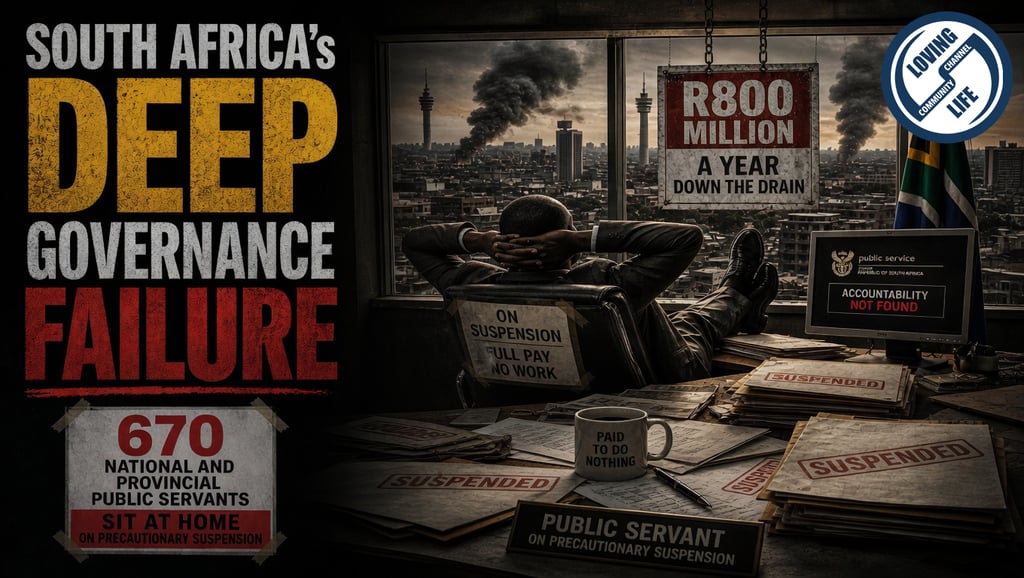
South Africa’s taxpayers are forking out a staggering R800 million every single year just to keep more than 670 national and provincial public servants on full pay while they sit at home on precautionary suspension. Many of them have been in this paid limbo for years. This is not a minor inefficiency or a rounding error in the budget. It is cold, hard cash ripped straight from the public purse. This money could have fixed potholes, stocked hospital shelves, paid teachers or kept the lights on in clinics. Instead, it is bankrolling officials who are not turning up for work. The outrage is real, and it is 100 percent justified. This is wasteful expenditure on a scale that should make every South African taxpayer furious.
According to the latest figures published by TimesLIVE and the Sunday Times on 3 May 2026, more than 670 officials across national and provincial administrations are currently on precautionary suspension. Of these, a staggering 516 have already been off the job for longer than the 90-day guideline set for finalising disciplinary processes. Some cases have dragged on for over a year. At least five have stretched beyond two years. The average cost per suspended official sits at around R1.2 million a year. This is the typical senior-level package for directors and deputy directors. While ordinary citizens queue for hours for basic services, battle unemployment above 30 percent, and watch their taxes disappear into a creaking system, hundreds of officials are effectively on long-term paid leave.
This is not a new problem that suddenly exploded. The Public Servants Association (PSA) reported in April 2026 that unresolved suspensions across all three spheres of government (national, provincial and local) have already cost taxpayers more than R1 billion over the past five financial years. The union rightly labelled it “wasteful expenditure” caused by “serious weaknesses in governance and discipline management.” Precautionary suspension was never meant to become a years-long paid holiday. It was designed as a short-term safeguard while serious allegations (fraud, corruption, financial misconduct) are investigated. In practice, it has become a black hole that swallows public money with almost no accountability.
Real people, real money, real scandal. Take the deputy director in the Department of Women, Youth and People with Disabilities who has been suspended since 2018 on allegations of financial misconduct. She has already pocketed more than R5 million in salary while her case crawls through the labour court. That single case could have funded entire programmes to fight gender-based violence or create youth jobs. In Emfuleni municipality, two officials suspended for seven years have together cost taxpayers almost R9 million. A teacher in Mpumalanga stayed on suspension for nine years. These are not cherry-picked extremes. They are documented examples of a system that has simply stopped working.
Public Service Commission chairperson Professor Somadoda Fikeni has called it exactly what it is: a symptom of “deep governance failure.” Some suspensions, he warns, are outright malicious. They are tools used to sideline whistle-blowers or honest officials so that others can continue looting state resources. The mechanics are depressingly familiar. Disciplinary hearings are postponed again and again because documents go missing, witnesses fail to appear, labour relations units are understaffed, or lawyers play delay tactics. Cases bounce endlessly between internal panels, the Public Service Coordinating Bargaining Council, labour courts and the High Court. Meanwhile the officials stay home, salaries keep flowing, and the posts they left behind either remain vacant or are filled by expensive acting appointments.
Taxpayers get hit twice. First they pay the suspended official’s full package, including salary, benefits and pension contributions. Then they pay again for the person (or consultant) who has to do the actual work. Or they simply suffer the consequences of unfilled posts: longer queues at Home Affairs, delayed social grants, broken municipal services and understaffed clinics. The public wage bill already consumes nearly one-third of consolidated government spending. Every rand wasted on non-working officials is a rand that cannot go to service delivery in a country already struggling with crumbling infrastructure and rising debt.
The numbers have been climbing steadily. In 2022, 305 officials cost R131 million. By 2024 estimates had risen toward R240 million annually for national and provincial alone. Today’s R800 million figure for just over 670 people shows the problem is accelerating, not shrinking. Senior managers are often involved, which means policy stalls, decisions get delayed and accountability evaporates at the very top.
No one is arguing against fairness. The law and public service regulations require full-pay precautionary suspension for serious cases to protect both the investigation and the rights of the accused. That principle is sound. But fairness does not mean indefinite paid leave. Regulations demand that disciplinary processes be concluded within reasonable timeframes. Heads of department are supposed to take personal responsibility for timely resolution. Yet the Public Service Commission and the unions point to the same chronic failures year after year: weak HR capacity, terrible record-keeping, and a culture where no one is ever held answerable for endless delays.
Ordinary South Africans have every right to be angry. Their taxes fund this parallel system of paid non-work while hospitals run short of medicine, schools lack textbooks, and municipalities drown in debt. This is not merely inefficiency. It is a betrayal of the social contract. When the state cannot discipline its own employees, it loses moral authority to demand anything from citizens.
Solutions exist and they are not complicated. Enforce strict time limits on disciplinary processes. Set 60 days for investigation and 30 days for hearing, with automatic consequences for unjustified delays. Hold heads of department personally accountable through performance agreements and financial penalties for protracted cases. Beef up labour relations capacity in every department with dedicated, trained personnel. Introduce digital case-management systems so files cannot simply go missing. And where suspensions are found to be malicious or vexatious, those responsible must face consequences themselves.
The PSA has called for exactly this: urgent enforcement of timeframes and stronger internal capacity. Professor Fikeni has echoed the need to eliminate this haemorrhaging of public resources. Parliament’s oversight committees must treat this as a standing agenda item, not a once-off report. The Auditor-General should flag long-term suspensions as irregular expenditure in departmental audits.
South Africa cannot afford to keep writing blank cheques to suspended officials while essential services collapse. The R800 million annual price tag is not an accounting footnote. It is a national disgrace that demands immediate, decisive action. Taxpayers have every right to demand better. The question now is whether those in power will finally act, or whether this grotesque waste will simply roll on into another financial year.