
Security Breach at Lyttelton Military Base: A Wake-Up Call for South Africa
A major security breach at SANDF’s Tek Base in Pretoria has left three R4 assault rifles and a grenade launcher missing after intruders cut through the perimeter fence. This is the second major theft at the same facility since 2019. As South Africa battles rising violent crime, this latest incident exposes dangerous weaknesses in military security and raises fresh fears about weapons leaking onto the streets.

Introduction
The recent theft of military grade weapons from Tek Base in Lyttelton, part of South Africa’s Thaba Tshwane military precinct, has sent shockwaves through the defence community and the public alike. Occurring on 27 April 2026, this incident is not merely a case of stolen equipment but a stark symptom of deeper systemic vulnerabilities within the South African National Defence Force (SANDF). In a country already struggling with high levels of violent crime and illegal firearms proliferation, the breach raises urgent questions about the security of national arsenals and the potential risks these stolen weapons pose to civilian safety.
The Incident: A Seamless Breach
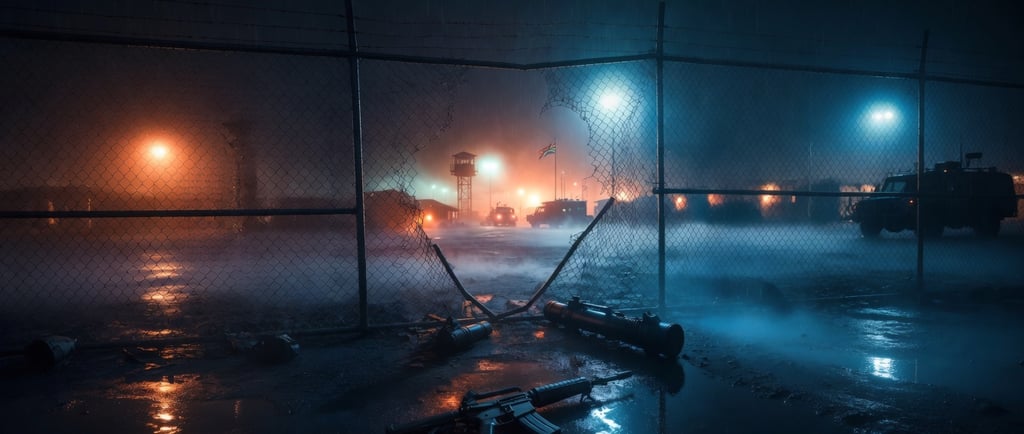
Under the cover of what appears to have been a carefully planned operation, intruders cut through the perimeter fence of Tek Base and forced open a storeroom door. They made off with at least three R4 assault rifles and a grenade launcher, with some reports indicating two 40mm variants. The theft remained undetected until midday when a soldier returning to duty discovered the break in. There were no alarms triggered, no signs of immediate resistance, and no witnesses to the actual event. This level of audacity, breaching a military installation in one of the country’s most secure precincts, highlights significant gaps in both physical security and surveillance protocols. Preliminary investigations suggest the perpetrators used basic tools, raising concerns about how such a low tech attack could succeed against what should be a high security facility.
History of Security Failures
Unfortunately, this incident is not an anomaly. The same Tek Base suffered a major theft in December 2019, when 18 R4 assault rifles and several pistols were stolen in what was widely believed to be an insider assisted operation. Many of those weapons later appeared in cash in transit robberies across the country, demonstrating how military grade arms can quickly fuel organised crime. Despite subsequent reviews and promises of improved security measures following the 2019 breach, history has repeated itself at the exact same location. This pattern points to chronic issues: inadequate perimeter monitoring, insufficient internal audits, possible corruption or negligence, and a failure to learn from past incidents. The recurrence undermines public confidence in the SANDF’s ability to safeguard its own resources.
The Broader Implications
The implications of this breach extend far beyond the immediate loss of hardware. South Africa continues to face escalating violent crime, with illegal firearms playing a central role in gang conflicts, farm attacks, robberies, and township shootings. Many of these weapons are suspected to have leaked from official stockpiles, whether through theft, corruption, or poor management. Each stolen R4 rifle or grenade launcher increases the lethality of criminal elements and places additional pressure on already strained law enforcement agencies.
Politically, the timing is particularly damaging. As debates around gun control, disarmament policies, and police reform continue, this incident serves as a powerful counter narrative, showing that even state controlled weapons are not secure. The potential for these arms to reach criminal syndicates or even destabilising elements poses a direct threat to national security and community safety. Economically, it also represents a waste of taxpayer resources at a time when the SANDF faces budget constraints and operational challenges.
Public Response and Accountability
In response, the SANDF has confirmed the theft and is working alongside the South African Police Service (SAPS) and Thaba Tshwane Military Police. A formal case of business burglary has been opened, and investigations are ongoing to determine whether more items were taken and to trace the perpetrators. However, many South Africans remain sceptical. Public discourse on social media and in news commentary has been sharp, with questions focusing on leadership accountability, the effectiveness of previous security upgrades, and the need for independent oversight.
How can a military base with presumably advanced security systems fall victim to such a straightforward breach? What vetting processes exist for personnel? Are there adequate surveillance technologies and rapid response protocols in place? These are the uncomfortable questions that demand transparent answers if trust is to be restored.
Conclusion: The Need for Reform
The Lyttelton breach is more than a logistical failure. It is a wake up call about institutional fragility within South Africa’s defence establishment. In a nation where illegal firearms may already outnumber legal ones in many regions, every stolen military weapon heightens the stakes for public safety.
Moving forward, comprehensive reforms are essential. These should include upgraded perimeter technologies (such as motion sensors, AI driven cameras, and reinforced fencing), stricter internal audits, better personnel screening, and independent reviews of security protocols across all SANDF facilities. Without decisive action, the cycle of breaches will likely continue, further eroding confidence in the military’s readiness and competence.
As the investigation unfolds, citizens deserve more than standard statements. They need concrete evidence that lessons have been learned and that their defence force can reliably secure the very tools meant to protect the nation. Until these systemic cracks are properly addressed, both military installations and the communities they serve remain vulnerable, perpetually one compromised fence away from the next crisis.